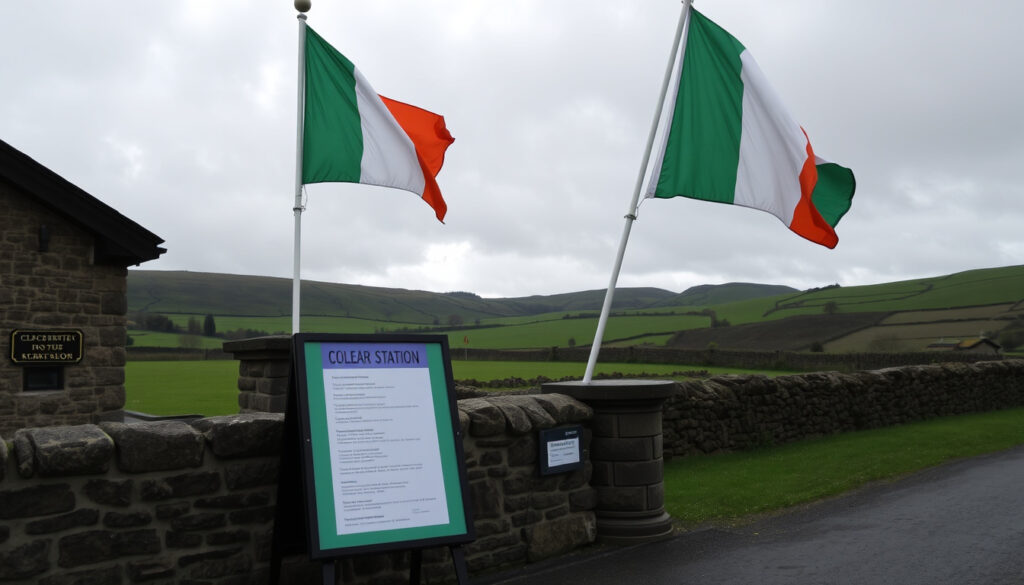
How to Check Your Polling Station Queue in Ireland
If you’ve ever wondered whether your local polling station will be packed when you arrive, you’re not alone. Election day brings a predictable surge, especially in the final hours before doors close. The good news is that Ireland’s system makes it relatively easy to plan your visit — you just need to know which tools to use and when to time your arrival smartly.
Polling stations open: 7am · Polling stations close: 10pm · Official finder: electoralcommission.ie · Polling card required: No, but recommended · Local example: Fingal and South Dublin
Quick snapshot
- Open 7am–10pm nationwide (Vote.ie)
- Queue before 10pm means you still vote (Electoral Commission UK)
- Poll card speeds up verification (Limerick Leader)
- No official real-time queue tracker exists for Irish polling stations (Electoral Commission Ireland)
- Limited voter-reported queue status via social media (Electoral Commission Ireland)
- No county-level queue monitoring apps confirmed (Electoral Commission Ireland)
- Poll cards posted before election day (Vote.ie)
- Stations busiest after 7pm (Electoral Commission UK)
- General Election 2024: November 29, 2024 (Limerick Leader)
- Check your station via electoralcommission.ie/where-to-vote
- Presidential count begins Saturday 25 October 2025
- Contact local authority if no poll card received
Six core facts, one persistent gap: Irish voters have reliable tools for locating their polling station, but no centralized digital system tracks real-time queue lengths at any location nationwide.
| Label | Value |
|---|---|
| Open time | 7am daily |
| Close time | 10pm |
| Vote without card | Yes |
| Finder site | electoralcommission.ie/where-to-vote |
What time do polling stations open in Ireland?
Every polling station in the Republic of Ireland opens at 7am on election day and stays open until 10pm. This uniform schedule applies nationwide, whether you’re voting in Dublin, Cork, or Galway. The same hours apply in Northern Ireland, where polling stations open at 7am and close at 10pm (Electoral Office for Northern Ireland).
Standard opening time
The 7am opening is confirmed across multiple government sources and applies to every election type, including general elections, local elections, and referendums (Vote.ie). Staff verify your name, address, and ID at the polling desk before you receive your ballot paper.
Variations by location
While opening times are identical, the physical locations vary. Polling stations are typically set up in local schools, community halls, or council buildings. Your specific station appears on the polling information card mailed to your registered address before election day (Electoral Commission Ireland).
Morning arrivals minimize wait times, but most voters work standard hours. The practical choice is between a short morning queue or risking a 15–30 minute wait during afternoon peaks.
Polling station locations
Finding your designated polling station relies on either your polling information card or official online tools. There’s no app or digital tracker showing real-time crowd levels, but you can confirm your exact location well before election day.
Find your polling station
The Electoral Commission Ireland provides a dedicated finder tool at electoralcommission.ie/where-to-vote. Enter your address, and the system returns your assigned station and its address. If you haven’t received your poll card, check the same site or visit CheckTheRegister.ie, the government voter registration portal (Electoral Commission Ireland).
Fingal and South Dublin examples
For Fingal and South Dublin residents specifically, local authority websites list polling station locations if your card hasn’t arrived. You can also call or email your local authority electoral office for confirmation. The General Election 2024 saw 43 constituencies across Ireland elect 174 TDs (Teachta Dála), with polling stations distributed accordingly (Limerick Leader).
Morning voters sidestep queues but face tighter time constraints. Afternoon voters save time during the day but face longer waits, particularly after 7pm when traffic peaks.
Polling stations closing time
All polling stations close at 10pm sharp. However, the Electoral Commission makes clear that voters who joined the queue before 10pm will still be allowed to vote, even if processing continues past the closing time. This rule prevents anyone who arrived on time from being turned away (Electoral Commission UK).
Standard closing time
The 10pm closing applies uniformly across all constituencies. Staff at each station maintain a record of voters in queue at closing, ensuring orderly processing. No campaigning or posters are permitted within 50 metres of any polling station (Limerick Leader).
Queue after close
The queue-before-close rule is critical for anyone planning a late-evening visit. If you arrive at 9:58pm and join a queue, you’ll vote. This policy aligns across the island: Northern Ireland applies the same rule (Electoral Office for Northern Ireland).
If there’s a queue at your polling station, you’ll still be able to vote as long as you joined the queue before 10pm.
— Electoral Commission UK (Official Guidance)
Can I vote without polling card Ireland?
Yes, you can vote without your polling card. The card is helpful for speeding up the identification process, but it’s not mandatory. Voters must vote only at their designated polling station based on their registered address, but the card itself is not required at the booth (Electoral Commission Ireland).
Requirements
Staff verify your name and address against the electoral register. Some elections require photographic ID (passport, driving licence, Public Services Card), while others accept non-photo alternatives like credit cards, cheque books, or birth certificates. The specific ID requirements depend on the election type (Limerick Leader).
What to bring instead
If you don’t have your poll card, bring an accepted form of ID. Acceptable photo ID includes passport, driving licence, or Public Services Card. If photo ID isn’t available, credit cards, cheque books, and birth certificates are listed as alternatives. Without any ID, staff may still verify your identity through other means, but having documentation eliminates uncertainty.
Where is my polling station Fingal?
Fingal residents can locate their polling station through multiple channels. Your poll card shows your assigned station directly. If you haven’t received it, the Electoral Commission finder and CheckTheRegister.ie both accept Fingal addresses for location lookups (Electoral Commission Ireland).
Fingal specific finder
The main finder at electoralcommission.ie/where-to-vote covers all local authority areas including Fingal. Simply enter your Eircode or address, and the tool returns your station details. Local authority websites for Fingal County Council also maintain polling station lists for reference.
General Ireland tools
Beyond Fingal-specific resources, voters anywhere in Ireland can use CheckTheRegister.ie to verify their registration status and station assignment. The Presidential Election 2025 count is scheduled to begin Saturday 25 October 2025 at central count centres, with Dublin Castle as one location (Presidential Election Ireland).
Northern Ireland requires photographic ID universally, unlike some Republic of Ireland elections where alternatives are accepted. Border voters should verify ID requirements for their specific election type before arriving.
How to check polling station queue in real-time
Here’s the honest reality: no official real-time queue monitoring system exists for Irish polling stations. The Electoral Commission Ireland does not provide any app, website dashboard, or digital tracker showing current wait times at specific locations (Electoral Commission Ireland). Official guidance focuses on helping voters find their station, not monitoring crowd flow.
Unofficial methods
Without a centralized tracker, voters resort to informal methods. Social media platforms sometimes carry informal reports from voters sharing wait experiences, but this information is unreliable, unverified, and not official. Some voters call their local authority directly to ask about conditions, though staff typically cannot confirm real-time queue status.
Best practical approach
- Check electoralcommission.ie/where-to-vote before election day to confirm your station location
- Review your polling card for your specific station address
- Call your local authority electoral office if you have concerns about accessibility or special arrangements
- Consider early morning voting (before 9am) for shortest wait times
- Avoid arriving between 7pm and 10pm if minimizing queue time is your priority
The implication: Ireland’s polling system works well for station location but hasn’t invested in real-time crowd monitoring. For now, timing your visit strategically remains the most effective queue management tool available to voters.
Related reading: Red Dot United Manifesto GE2025 · GST Voucher 2025 Payout Date
While no real-time queue tracker exists, Ireland offers no pre-poll voting, so check your Ireland polling stations and times via the electoral site to plan ahead.
Frequently asked questions
How to check polling station queue in real-time?
There is no official real-time queue monitoring tool for Irish polling stations. The Electoral Commission Ireland does not offer a queue tracker. Your best options are arriving early, checking social media for informal voter reports, or calling your local authority directly—but none provide verified real-time data.
What if queues are long on election day?
If you join the queue before 10pm, you will still vote even if processing continues after closing time. Stations typically get busiest after 7pm. If you want to avoid queues, vote before 9am or between 10am and 4pm.
Are there apps for polling station queues?
No official queue-tracking apps exist for Irish polling stations. The Electoral Commission Ireland provides station location tools but not wait-time monitoring. Some third-party apps claim to track voting conditions, but their data is unverified.
How early should I arrive to avoid queues?
Arriving before 9am typically means minimal to no waiting. Voting between 10am and 4pm usually involves moderate waits of 5–15 minutes. After 7pm, expect longer queues as the day’s final voters arrive.
Does polling station queue affect closing time?
No. Stations close at 10pm, but anyone already in the queue at that time is still permitted to vote. This rule applies uniformly across all Irish polling stations and similar rules exist in Northern Ireland.
Where to report polling station issues?
Report issues to your local returning officer or contact the Electoral Commission Ireland directly. For problems on election day, polling station staff can escalate urgent matters to supervisory personnel.
Is queue info on electoralcommission.ie?
No. The Electoral Commission Ireland website provides station location finders and voter registration tools, but no queue status, wait-time data, or real-time crowd monitoring. Their official guidance focuses on helping voters locate their designated station.
You can only vote in your designated polling station.
— Electoral Commission Ireland (Official Body)
It could be all over as early as 9:30am if the outcome is as decisive as the polls predict.
— Returning Officer (Election Official)
For Irish voters, the real-time queue check gap is a practical limitation rather than a systemic failure. Official tools reliably direct you to your correct station, and the queue-before-close rule protects late arrivals. The tradeoff is clear: plan your visit for morning or midday hours if minimizing wait time matters, or accept that evening voting means sharing the station with everyone else who waited until the last minute.
More related posts
 Weather in Singapore Tomorrow – Hot, Humid with 75% Evening Storms
 Xiang Xiang Hunan Cuisine – Hunan’s Distinct Spicy Style
 Ling Ling by the Wine Company: Menu, Reviews & Tips
 Best Car Insurance Singapore 2026: Top Quotes & Comparisons
 Naslen K. Gafoor: Age, Movies, Girlfriend, Family, Religion
 100 USD to SGD: Convert US Dollars to Singapore Dollars Rate
 1 SGD to GBP: Why the Singapore Dollar Beats the Pound
 আজকের সিঙ্গাপুর নামাজের সময় ২০২৪-২০২৬ | পাঁচ ওয়াক্ত সময়সূচী
