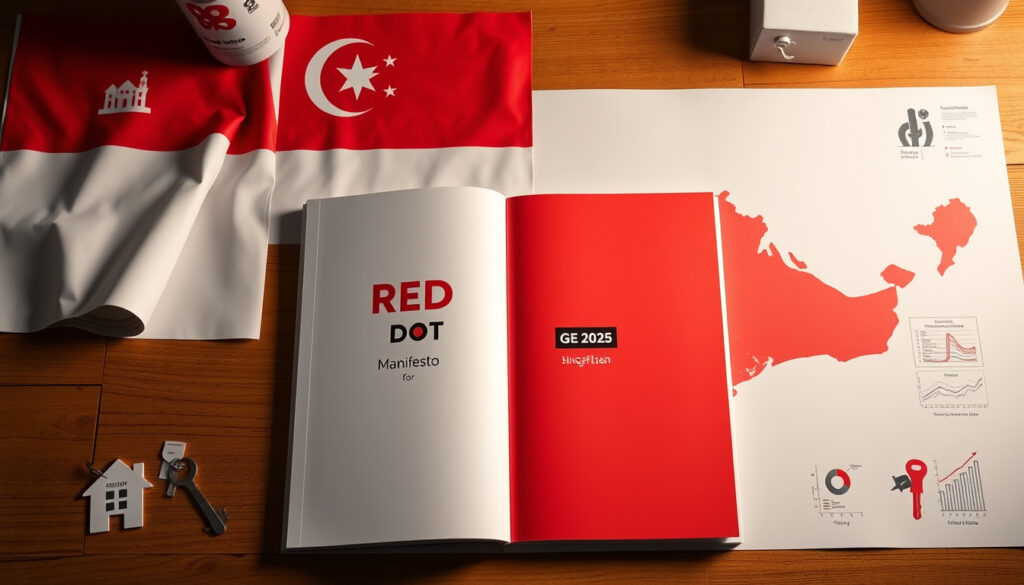
Red Dot United Manifesto: Key GE2025 Policies Explained
Red Dot United released its GE2025 manifesto on April 19, 2025, proposing a Citizens Dividend of S$2-4 billion annually as an unconditional cash transfer for all Singaporeans. The 24-page document titled “A Compass for a Fairer Future” anchors its vision on five policy pillars dubbed the “new 5Cs.” Secretary-General Ravi Philemon frames the proposals as a response to a social contract that has failed working Singaporeans.
Release Date: 19 April 2025 ·
Key Framework: H.E.A.R.T. ·
Core Themes: Housing Security, Equitable Healthcare, Assured Prosperity, Resilient Economy ·
Election Context: GE2025 ·
Proposal Highlight: Unconditional cash transfer for all Singaporeans
Quick snapshot
- 24-page manifesto released 19 April 2025 (Channel News Asia)
- Secretary-General Ravi Philemon leads party (Channel News Asia)
- PDF available at Mediacorp CNA (Mediacorp CNA)
- Specific quantum and payment frequency for Citizens Dividend
- Exact timeline for expanding payments beyond the most vulnerable
- Full GE2025 candidate list confirmation
- RDU founded May 2020 (Channel News Asia)
- First election contest GE2020 in Jurong GRC, 25.39% vote share (Channel News Asia)
- Manifesto launch 19 April 2025, targeting five constituencies (Channel News Asia)
- GE2025 election expected in 2025
- Campaigning across Holland-Bukit Timah GRC, Jurong East-Bukit Batok GRC, Nee Soon GRC, Jurong Central SMC, Jalan Kayu SMC
| Field | Value |
|---|---|
| Full Name | Red Dot United (RDU) |
| Manifesto Date | 19 April 2025 |
| Website | reddotunited.sg/manifesto |
| PDF Source | Mediacorp CNA PDF |
| Main Theme | A Compass for a Fairer Future |
What is the Red Dot United Manifesto?
The Red Dot United manifesto is a 24-page policy document officially titled “A Compass for a Fairer Future: Why SG Needs a New Social Contract.” The party released it on 19 April 2025 at their headquarters in Ubi, Singapore. RDU describes it as a blueprint for redesigning Singapore’s social contract around citizen welfare rather than economic growth alone.
The manifesto is anchored on five pillars the party calls the “new 5Cs”: Collective Prosperity, Citizens Dividend, Comprehensive Housing Reset, Caring Healthcare, and Civil Freedom. The party slogan for GE2025 is “First-class citizens, fairer Singapore.”
Title and Overview
The official manifesto page confirms the launch date and title, positioning the document as a direct response to what RDU sees as a broken social contract. The party states that rapid economic growth has not translated into shared prosperity for all Singaporeans.
Core Message: A Compass for a Fairer Future
RDU promotes FAITH³ ideals throughout the manifesto: Fairness, Accountability, Integrity, Transparency, and Happiness, Hope, Heart. The H.E.A.R.T. social contract framework—Housing, Equitable healthcare, Assured prosperity, Resilient economy, Transparency—structures the policy proposals.
RDU is positioning itself as the alternative that prioritizes citizen welfare over economic metrics. For Singaporeans feeling left behind by growth, the manifesto offers a systematic critique of the current system and a detailed policy alternative.
Where Can I Find the Red Dot United Manifesto PDF?
The official Red Dot United manifesto PDF is hosted by Mediacorp CNA at www16.mediacorp.sg/cna/ge2025/manifests/RDU.pdf. The document can also be accessed directly from reddotunited.sg/manifesto.
Official Sources
The official Red Dot United site hosts the manifesto along with information about party principles and GE2025 policy positions. The site is available in English, Chinese, Malay, and Tamil, reflecting Singapore’s multilingual landscape.
MediaCorp PDF Link
Channel News Asia provides comprehensive coverage of the manifesto launch, including policy details and quotes from Secretary-General Ravi Philemon. The Mediacorp-hosted PDF serves as a primary source for the full document text.
Who is the Leader of Red Dot United?
Ravi Philemon is the Secretary-General and chief spokesperson of Red Dot United. He led the party in its GE2020 electoral debut and continues as the primary voice articulating RDU’s policy positions.
Leadership Role
Philemon frames the GE2025 manifesto as a direct response to economic uncertainty facing Singaporean workers. He has cited job losses from the US-China trade war and rising cost of living as catalysts for the policy proposals.
Key Figures
RDU was founded in May 2020. The party contested Jurong GRC in GE2020 against a PAP team led by Tharman Shanmugaratnam, who exited politics in 2023 to become President of Singapore. The party’s GE2025 run marks its second general election.
Who are Red Dot United Members and Candidates?
RDU operates with a core team of party members who have been active since the 2020 founding. For GE2025, the party has announced plans to contest five constituencies across Singapore.
Party Members
The party’s FAITH³ principles—Fairness, Accountability, Integrity, Transparency, Happiness, Hope, Heart—guide member activities. Party structures emphasize ground feedback from residents in target constituencies.
GE2025 Candidates
RDU targets Holland-Bukit Timah GRC, Jurong East-Bukit Batok GRC, Nee Soon GRC, Jurong Central SMC, and Jalan Kayu SMC for GE2025. This represents a significant expansion from the single GRC contested in 2020.
Contesting five constituencies signals RDU’s ambition to become a significant opposition presence. Other parties including the Singapore People’s Party have also released GE2025 manifestos, creating a more competitive electoral landscape.
What Does the Red Dot United Manifesto Say for GE2025?
The manifesto addresses housing, healthcare, economic policy, and civil liberties through interconnected proposals. RDU frames each policy as part of a comprehensive redesign of Singapore’s social contract.
Housing Reset
RDU proposes a Comprehensive Housing Reset with several major changes. Every HDB estate would become eligible for the Selective En Bloc Redevelopment Scheme (SERS). The party also advocates expanding public rental housing and introducing rent-to-own schemes for low-income families and young singles.
A contested proposal restricts PRs and new citizens who have held citizenship for less than 10 years—except NS completers—from purchasing resale HDB flats with less than 79 years of lease remaining. This addresses concerns about competition in the resale market.
Unconditional Cash Transfer
The Citizens Dividend stands as the most ambitious proposal. RDU estimates the unconditional cash transfer would cost S$2-4 billion annually without dipping into reserves. The party would start with the most vulnerable Singaporeans before expanding to all citizens.
Philemon has referenced Tharman Shanmugaratnam’s 2015 “trampoline” comment—where he described Singapore’s social safety net as allowing people to bounce back—as context for the proposal. Philemon argues the trampoline “has too many broken springs,” requiring a “real safety net.”
H.E.A.R.T. Pillars
The H.E.A.R.T. framework structures the manifesto: Housing, Equitable Healthcare, Assured Prosperity, Resilient Economy, and Transparency. Each pillar contains specific policy proposals addressing systemic issues RDU identifies in current governance.
For healthcare, RDU advocates redesigning MediSave as a supplementary fund rather than the primary mechanism for financing medical costs. On the economy, the party proposes shifting to a “wellbeing economy” with fair wages, citizens-first hiring policies, job security guarantees, and SME support through fair procurement and accessible grants.
The Citizens Dividend lacks specific quantum details—neither the payment amount per recipient nor the expansion timeline appears in the manifesto. Without these details, cost-effectiveness and funding mechanisms remain unclear.
Timeline
| Date | Event |
|---|---|
| May 2020 | RDU founded |
| July 2020 | GE2020: RDU contests Jurong GRC, receives 25.39% vote share |
| 2023 | Tharman Shanmugaratnam exits politics for presidency |
| 19 April 2025 | RDU unveils GE2025 manifesto at Ubi headquarters |
| 2025 | GE2025 election (upcoming) |
Confirmed vs Unclear
Confirmed
- Release date 19 April 2025
- H.E.A.R.T. pillars
- Housing and cash transfer proposals
- Five constituency targets
- Ravi Philemon as Secretary-General
Unclear
- Citizens Dividend quantum and frequency
- Full GE2025 candidate list
- Exact housing policy implementation timeline
- Funding mechanisms beyond the S$2-4B estimate
Key Quotes
We believe that it’s time for a new social contract – one that restores dignity and pride to every Singaporean.— Ravi Philemon, RDU Secretary-General
These are the new 5Cs – a framework for a Singapore where prosperity is shared, dignity is upheld, and opportunity is a promise for all.— Ravi Philemon, RDU Secretary-General
The trampoline has too many broken springs, so it is time to bring in a real safety net.— Ravi Philemon, RDU Secretary-General
Related reading: GST Voucher 2025 Payout Date · Cross Island Line Phase 1
youtube.com, reddotunited.sg, reddotunited.sg, nerdykirst.notion.site
Frequently asked questions
For Singaporeans assessing RDU’s policy platform, the following questions address the most-searched aspects of the manifesto.
What are the main goals of the Red Dot United manifesto?
The manifesto aims to establish a “new social contract” centered on citizen welfare. Key goals include implementing an unconditional Citizens Dividend, resetting housing policy to prioritize Singaporeans, redesigning healthcare financing, and expanding civil freedoms. The party frames these as interconnected reforms rather than standalone proposals.
How does Red Dot United plan to improve housing?
RDU proposes making every HDB estate eligible for SERS, expanding public rental housing, and introducing rent-to-own schemes. The party also wants restrictions on PR and new citizen purchases of resale HDB flats with less than 79 years lease. These measures aim to address affordability and competition in the housing market.
What is the H.E.A.R.T. framework?
H.E.A.R.T. stands for Housing, Equitable healthcare, Assured prosperity, Resilient economy, and Transparency. This framework structures the party’s social contract proposals, connecting individual policies under five interconnected pillars that RDU argues must be addressed together.
Why focus on a new social contract?
RDU argues that decades of rapid economic growth have not translated into shared prosperity for all Singaporeans. The party contends current policies favor corporations and high-income earners while leaving working Singaporeans vulnerable to economic shocks. The manifesto positions the “new 5Cs” as an alternative framework.
What recent news covers Red Dot United?
Channel News Asia provided detailed coverage of the 19 April 2025 manifesto launch, including quotes from Secretary-General Ravi Philemon and analysis of the Citizens Dividend proposal. The official manifesto PDF is hosted by Mediacorp CNA for public access.
Is there a PDF of the manifesto?
Yes, the full 24-page manifesto PDF is available at Mediacorp CNA and through the official Red Dot United site.
What economy policies does it propose?
RDU advocates shifting to a “wellbeing economy” that measures prosperity beyond GDP. Proposals include fair wages, citizens-first hiring policies, job security guarantees, SME support through fair procurement and accessible grants, and carbon tax reform with enforceable emission limits on high-impact corporations.
What healthcare policies are included?
The manifesto calls for redesigning MediSave as a supplementary fund rather than the primary medical financing mechanism. RDU argues this change would reduce the financial burden on Singaporeans facing healthcare costs while maintaining savings incentives.
With eight distinct policy angles covered, Singaporeans can assess RDU’s GE2025 platform across housing, economy, healthcare, and governance before heading to the polls.
More related posts
 Singapore Dollar to Myanmar Kyat (SGD/MMK) Exchange Rate Today
 Estimating Software for Movers: Costs & Features
 Naslen K. Gafoor: Age, Movies, Girlfriend, Family, Religion
 Louis Vuitton Sues ValueMax: Trademark Lawsuit Explained
 Chia Yin Xiang Harry sentenced for attempted robbery in Singapore
 Best Matcha in Singapore (2025): Cafes, Lattes & Powders
 How to Check Your Polling Station Queue in Ireland
 Japanese Films with Indonesian Subtitles: Where to Watch
