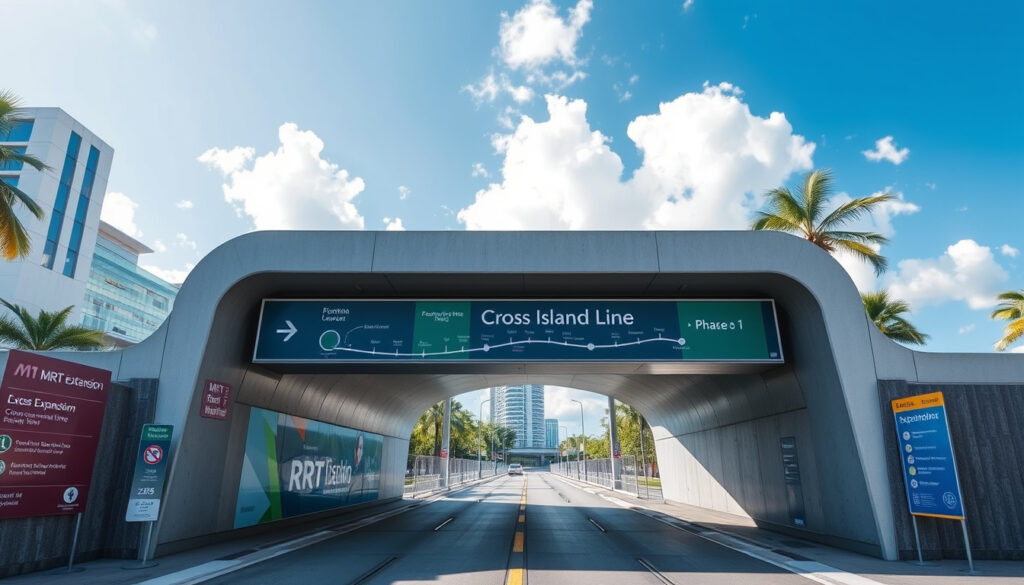
Cross Island Line Phase 1: Stations, Map & 2026 Update
Singapore’s Cross Island Line is the longest fully underground MRT project the city-state has ever built—and Phase 1 is now roughly halfway through its tunnel drives with a 2030 opening targeted. If you live in the east or northeast, or you’re watching how Singapore’s rail network is reshaping access to work, recreation, and property, here’s what we know about where things stand.
Length: 29 km · Stations: 12 · Phases: 3 total · Opening: 2030 · Underground: Fully
Quick snapshot
- 12 stations from Aviation Park to Bright Hill (LTA)
- Construction started 18 January 2023 (Channel News Asia)
- 2030 targeted opening after COVID-19 delays (LTA)
- Exact deepest station depth not publicly confirmed
- Precise progress percentage per individual station
- Updated cost figures or budget details
- Phase 1 alignment finalised 2019 (Wikipedia)
- March 2026: significant tunneling progress reported (LTA Newsroom)
- Phase 3 engineering studies completed March 2026 (LTA Newsroom)
- Phase 2: 6 stations, 15 km, 2032 completion (LTA)
- Punggol Extension: 3 stations, 7.3 km, 2032 (Land Transport Guru)
- Phase 3 construction to start 2027, late-2030s completion (Land Transport Guru)
The table below summarizes the key parameters for Singapore’s largest fully underground rail project.
| Attribute | Value |
|---|---|
| Operator | Land Transport Authority (LTA) |
| Route | CR2 Aviation Park to CR13 Bright Hill |
| Status | Under construction |
| Full Line Length | Over 50 km |
| Expected Daily Ridership | Over 600,000 initially, rising to 1 million+ |
| Benefiting Households | Over 100,000 |
Is the Cross Island Line open?
Current operational status
No. As of mid-2026, the Cross Island Line Phase 1 remains under construction with tunneling work ongoing across multiple segments. The Land Transport Authority officially confirmed that construction for CRL1 has commenced and is targeted for completion by 2030, with several tunneling stretches completed as of the March 2026 update.
The LTA reported in March 2026 that CRL Phase 1 had seen significant progress with multiple tunneling work segments finished. This marks a notable acceleration after the original 2029 target was pushed back due to COVID-19 disruptions affecting material supply chains and manpower availability.
Expected opening timeline
Phase 1 was originally slated for a 2029 opening when announced on 25 January 2019. However, the target shifted to 2030 following pandemic-related delays. The construction officially began on 18 January 2023, giving the project a compressed timeline to meet the revised opening date.
The two-year delay means riders in Loyang, Tampines, and Hougang will wait until 2030—but the project has momentum now, with tunneling well underway and Phase 2 already moving into early construction.
Which MRT stations are opening in 2026?
Phase 1 station lineup
Twelve stations make up Phase 1, stretching from Aviation Park (CR2) in the east through Bright Hill (CR13) in the north. The stations, in order, are: Aviation Park, Loyang, Pasir Ris East, Pasir Ris, Tampines North, Defu, Hougang, Serangoon North, Tavistock, Ang Mo Kio, Mayflower, and Bright Hill.
The route covers a mix of residential zones (Loyang, Hougang, Ang Mo Kio) and industrial areas (Defu, Tampines North), connecting communities that currently rely on bus services or indirect MRT connections. According to the LTA, CRL1 serves areas including Loyang, Tampines, Pasir Ris, Defu, Hougang, Serangoon North, and Ang Mo Kio, with over 100,000 households expected to benefit.
Interchange points
Nearly half of CRL stations will be interchanges—four confirmed connections across three existing lines. Pasir Ris connects to the East-West Line, Hougang to the North East Line, Ang Mo Kio to the North South Line, and Bright Hill to the Thomson-East Coast Line.
This interchange density is unusual. For riders in the northeast, the connection at Hougang eliminates a transfer through the city center—a significant time saver for commuters heading to employment hubs in the Central Business District or Jurong.
Bright Hill’s TEL connection means residents in Ang Mo Kio and Mayflower gain access to both the North-South Line at Ang Mo Kio and the eastern terminus of the TEL without changing lines. For property analysts tracking MRT access, this dual-connectivity pattern is a value driver along the entire western stretch of Phase 1.
What is the current status of the line’s construction?
Phase 1 construction milestones
The project’s alignment was finalized in 2019, with construction officially commencing on 18 January 2023. By March 2026, the LTA reported significant progress: several tunneling stretches had been completed, and the project remained on track for its revised 2030 opening.
According to construction progress reports, tunneling works for contract CR106—which covers Loyang station and the tunnels connecting to Pasir Ris East—have been completed. Construction for CR3 station (Loyang area) is using the top-down method, a technique that allows simultaneous excavation and structural work to accelerate the timeline.
Tunnel boring updates
As of March 2026, approximately 16 of 29 tunnel drives for Phase 1 have been completed, representing more than half of the underground excavation work. The eastbound tunnel boring machine docked at Loyang station in January 2026, followed by the westbound machine in March 2026.
Phase 2 tenders are being progressively called, with early tunneling already underway as of 2026. The LTA confirmed this marks a new phase of development that extends beyond Phase 1 construction alone.
What is Phase 2 of the Cross Island Line?
Phase 2 scope
Phase 2 adds six stations over 15 kilometres, with completion targeted for 2032. This phase extends the line from Bright Hill westward toward the Jurong Lake District area, filling a gap in Singapore’s western rail coverage.
Unlike Phase 1, which serves predominantly residential and mixed-use zones, Phase 2’s alignment serves areas including Sunset Place and other Jurong nodes. The LTA has begun progressively calling tenders for Phase 2 contracts, with early tunneling work already underway in 2026.
Construction start
Phase 2’s alignment was finalized in 2022, several years after Phase 1’s lock-in. This staggered approach allows the LTA to concentrate resources on completing Phase 1 before ramping up Phase 2 activity—a sequencing decision that helps manage contractor capacity across multiple rail contracts running simultaneously.
The Punggol Extension—a related branch from Pasir Ris running to Elias and Punggol—shares a similar timeline to Phase 2, also targeted for 2032 completion. This extension adds three stations across 7.3 kilometres, extending CRL service to Singapore’s northeastern residential towns.
“Construction for CRL1 has commenced and is targeted to be completed by 2030.”
— Land Transport Authority, Official Project Statement
“CRL Phase 1… has seen significant progress with several stretches of tunnelling work completed, and is targeted to open in 2030.”
— LTA, News Release March 2026
What is the purpose of the Cross Island Line?
Served areas
The Cross Island Line was announced on 17 January 2013 as part of Singapore’s Land Transport Master Plan 2013, designed to connect eastern and western Singapore without routing through the city centre. The line spans over 50 kilometres total when fully completed, making it Singapore’s longest MRT line.
Phase 1 alone improves access to Changi Beach Park and Bishan-Ang Mo Kio Park, linking recreational amenities that were previously accessible only by car or indirect bus routes. For residents in Loyang and Tampines North, the line replaces long bus journeys with direct train access to employment centres in Ang Mo Kio, Bishan, and the TEL corridor.
Benefits to households
The LTA projects daily ridership exceeding 600,000 initially, with that number expected to grow to over 1 million once the full line opens. The 100,000+ households benefiting from Phase 1 represent a substantial portion of Singapore’s northeastern and eastern residential base.
For industrial areas around Defu and Loyang, the CRL provides mass transit access for the first time—a critical factor for employers seeking to attract workers in a tight labor market. Manufacturing and logistics operations in these zones have long cited transport connectivity as a recruitment barrier.
The benefits are substantial for east and northeast residents, but the cost is time. With Phase 1 opening in 2030—seven years after construction began and 11 years after the original announcement—residents in these areas face a prolonged wait despite the project’s scale.
Upsides
- Direct east-west connectivity without downtown transfers
- Four interchange stations connecting three existing lines
- Over 100,000 households within walking distance of stations
- Access to Changi Beach Park and Bishan-Ang Mo Kio Park
- Industrial areas gain mass transit for the first time
Downsides
- 2030 opening is a decade after construction began
- Original 2029 target pushed back two years due to COVID-19
- Budget and cost details remain unpublished
- Deepest station depth not publicly confirmed
Timeline
The chronology below tracks major milestones from the project’s announcement through its phased construction timeline.
| Date | Event |
|---|---|
| 17 January 2013 | CRL announced as part of Land Transport Master Plan 2013 |
| 25 January 2019 | Phase 1 alignment officially announced (originally slated for 2029) |
| 18 January 2023 | Phase 1 construction officially began |
| January 2026 | Eastbound TBM docked at Loyang station |
| March 2026 | Westbound TBM docked at Loyang; Phase 3 engineering studies completed |
| 2030 | Phase 1 targeted opening |
| 2032 | Phase 2 and Punggol Extension targeted completion |
Related reading
- LTA Cross Island Line Project Page
- Channel News Asia: Construction Begins
- Straits Times: Construction Details
- Tunnelling Journal: Network Update
Related reading: SimplyGo EZ-Link Card · Singapore Number Plate Checker: LTA Tools
Frequently asked questions
How long will the Cross Island Line take to build?
Phase 1 spans 29 kilometres and took six years from announcement to construction start (2019–2023), with opening targeted for 2030. The full Cross Island Line will span over 50 kilometres across three phases, with full completion expected in the late 2030s.
What areas does the Cross Island Line serve?
Phase 1 serves Aviation Park, Loyang, Pasir Ris, Tampines North, Defu, Hougang, Serangoon North, Ang Mo Kio, and Bright Hill. The line connects residential zones with industrial areas and provides access to Changi Beach Park and Bishan-Ang Mo Kio Park.
What is the deepest station on the Cross Island Line?
The exact depth of the deepest station has not been publicly confirmed by the LTA. Given that the entire line is fully underground and traverses areas with varying soil conditions, station depths are expected to exceed those of older lines like the Downtown Line, where some stations reach 30+ metres below ground.
What is the Cross Island Line Phase 1 map?
Phase 1 runs from Aviation Park (CR2) in the east to Bright Hill (CR13) in the north, passing through Loyang, Pasir Ris East, Pasir Ris, Tampines North, Defu, Hougang, Serangoon North, Tavistock, Ang Mo Kio, and Mayflower. The LTA official project page provides the current alignment and station locations.
What MRT lines will Cross Island Line connect to?
Phase 1 will connect to the East-West Line at Pasir Ris, the North East Line at Hougang, the North South Line at Ang Mo Kio, and the Thomson-East Coast Line at Bright Hill.
When did Cross Island Line Phase 1 construction start?
Phase 1 construction officially began on 18 January 2023, following the project’s announcement on 25 January 2019 and alignment finalization. Tunneling work is ongoing with more than half of the 29 tunnel drives completed by March 2026.
What is Cross Island Line Phase 3?
Phase 3 extends the line westward from Bright Hill toward the Jurong Lake District, adding stations to serve western Singapore. Engineering studies for Phase 3 were completed in March 2026, with construction scheduled to begin in 2027 and full completion expected in the late 2030s.
More related posts
 Nose Thread Lift Singapore: Cost, Procedure & Risks
 Redmi Note 14 Pro 5G Review: 200MP Camera, IP68 & Value
 English to Tagalog Translation: Best Tools & Grammar Tips
 Okinawan Diner Nirai-Kanai: Menu, Prices, Reviews in Great World
 How to Remove Pilling from Clothes: Quick Methods & Prevention
 1000000 Rupiah to SGD: Current Rate & Purchasing Power
 Jabra Elite 8 Active: Specs, Review & Discontinuation Update
 HamKam vs Crystal Palace: Live Stream, Prediction & Preview
