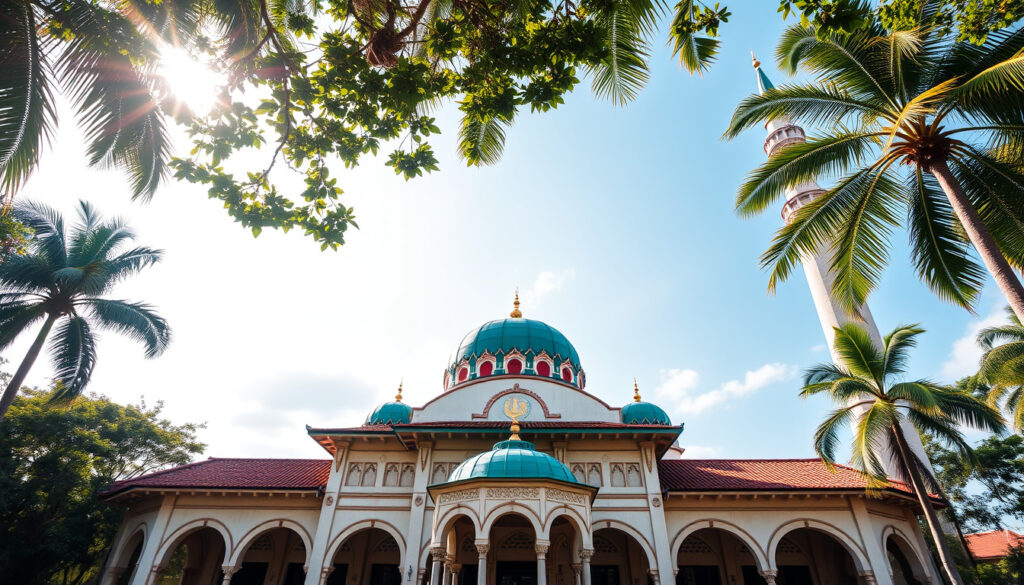
Masjid Omar Kampong Melaka: Singapore’s Oldest Mosque Guide
When Stamford Raffles laid out his vision for Singapore in 1819, one Arab merchant from Palembang saw a city worth building a future in. Syed Omar bin Ali Aljunied gave Singapore its oldest mosque—a wooden surau raised in 1820 that would become the spiritual anchor for an entire community.
Year Built: 1820 · Location: Keng Cheow Street, off Havelock Road, Singapore · Commissioned By: Syed Omar bin Ali Al-Junied · Status: Oldest mosque in Singapore · Original Structure: Wooden surau
Quick snapshot
- Established in 1820 as Singapore’s oldest mosque (National Library Board)
- First recorded wakaf in Singapore’s history (Muslim.sg)
- Located at 10 Keng Cheow Street, Singapore 059607 (MUIS)
- Precise dates for minor 19th-century expansions
- Whether exact opening hours for non-prayer visits are publicly documented
- Specific daily or Friday attendance figures
- 1820: Wooden surau built by Syed Omar
- 1855: Rebuilt in brick by Syed Abdullah
- 2001: Declared historic site by NHB
- 2009: Major renovations completed
- Continues serving office workers near Clarke Quay
- Annual descendant gatherings during Ramadan
- Ongoing religious education programs
Multiple official sources confirm the mosque’s key facts. The table below summarizes establishment, location, founder, and heritage status from government records.
| Detail | Information |
|---|---|
| Established | 1820 |
| Address | 10 Keng Cheow Street, Singapore 059607 |
| Founder | Syed Omar bin Ali Al-Junied |
| Significance | Oldest mosque in Singapore |
| Rebuilt | 1855 (brick structure) |
| Capacity | 500 worshippers |
| Declared Historic Site | 2001 (National Heritage Board) |
Who commissioned Masjid Omar Kampong Melaka?
Syed Omar bin Ali Aljunied arrived in Singapore shortly after Stamford Raffles established the settlement in 1819. An Arab merchant from Palembang, he saw the commercial potential of the emerging port—but more than that, he understood the spiritual needs of the growing Muslim community settling near Kampong Melaka.
Early patrons
In 1820, Syed Omar commissioned a simple wooden surau on land that had been allocated in the Raffles Town Plan of 1822 for the Muslim community. This act of establishing a place of worship was no small gesture—the National Archives of Singapore records his contribution as the first recorded wakaf (Islamic endowment) in Singapore’s history. His wealth came from trade, but his legacy was rooted in faith and community building.
Role of Aljunied family
Syed Omar’s nephew, Syed Abdullah bin Mohamed Al-Junied, continued the family’s commitment to this sacred site. When the original timber structure needed replacement, Syed Abdullah funded the construction of a permanent brick mosque in 1855. According to the National Archives of Singapore, the decision to rebuild came as the neighborhood grew following new road paving, with the expanded congregation requiring a larger space for worship.
Two generations of one Arab merchant family built Singapore’s oldest mosque from scratch and kept it standing through a major reconstruction. Without their combined investment, Kampong Melaka’s Muslim community would have had no permanent spiritual center in colonial Singapore.
What is the oldest mosque on Earth?
Masjid Omar Kampong Melaka holds a significant but bounded title—it is the oldest mosque in Singapore, not the oldest on Earth. Globally, mosques built in the 7th century in Arabia and Southeast Asia’s earliest Islamic settlements would far outpace it in age. The relevant comparison is regional: among Singapore’s mosques, Masjid Omar Kampong Melaka stands alone.
Global context
Mosques such as Masjid al-Haram in Mecca (built 638 CE) and various structures across Indonesia, Malaysia, and the Middle East predate Singapore’s founding by centuries. The world’s oldest purpose-built mosques date to the Rashidun Caliphate. Masjid Omar Kampong Melaka cannot compete chronologically with these foundations, but its significance for Singapore’s small Muslim population was immeasurable at the time.
Singapore’s standing
Within Singapore, no mosque predates Masjid Omar Kampong Melaka. The structure preceded Masjid Sultan (est. 1824) by four years, making it the undisputed oldest. Minister Abdullah Tarmugi, speaking at a National Archives event, confirmed this status, stating that Masjid Omar Kampong Melaka is recognized as the oldest mosque in Singapore. The National Heritage Board reinforced this by declaring it a historic site in 2001.
How old is Masjid Omar Kampong Melaka?
Masjid Omar Kampong Melaka has stood for over two centuries. From a humble wooden surau in 1820 to a declared national monument, the mosque has witnessed Singapore’s transformation from a trading post to a global city. Its age alone makes it a living link to the nation’s earliest Islamic community.
Construction timeline
The mosque was established in 1820 as a temporary timber building, reflecting the modest resources of the early Muslim community. By 1855, the community had grown enough to justify a permanent brick structure funded by Syed Abdullah bin Omar Aljunied. This 35-year gap between the wooden surau and the brick mosque marks the first major evolution of the site.
Evolution from surau
Over the next century and a half, the mosque continued to adapt to community needs. Reconstructive work in 1982 added an administrative building and ceremonial cleansing area. A 28-meter minaret with a small dome was added in 1985, giving the mosque its current silhouette. Major renovations in 2009, costing S$936,000 according to Hive Life, introduced new classrooms and a dedicated prayer area for women.
Where is Masjid Omar Kampong Melaka located?
The mosque sits at 10 Keng Cheow Street, Singapore 059607, tucked into the eastern edge of Chinatown near Clarke Quay. Finding it requires knowing that Keng Cheow Street runs off Havelock Road, a short walk from the Clarke Quay MRT station (NE5). The address places it squarely in Singapore’s historic core, surrounded by shophouses and the remnants of Kampong Melaka’s original layout.
Chinatown vicinity
Kampong Melaka was one of several villages allocated in Raffles’ 1822 Town Plan for specific ethnic and religious communities. The land set aside for Muslims became the foundation of a neighborhood that still carries the name of the Malaccan settlers who first gathered there. Today, Masjid Omar Kampong Melaka anchors this historic area, visible from the modern Clarke Quay entertainment district.
Access via MRT
Visitors traveling by train should alight at Clarke Quay MRT (North-East Line, NE5) and walk toward Havelock Road. From there, Keng Cheow Street is a brief stroll, making the mosque accessible to tourists exploring the riverside area. The walk takes approximately 5-7 minutes from the station exit.
Proximity to Clarke Quay MRT makes Masjid Omar Kampong Melaka one of Singapore’s most accessible heritage mosques for visitors. Unlike some older religious sites tucked away in housing estates, this mosque sits on the tourist trail, inviting casual visits rather than demanding dedicated pilgrimages.
Is Masjid Omar Kampong Melaka the oldest mosque in Singapore?
Yes, definitively. Multiple official sources confirm this status. The National Library Board, MUIS (Majlis Ugama Islam Singapura), and the National Heritage Board all recognize Masjid Omar Kampong Melaka as Singapore’s oldest mosque. This isn’t contested among historians or heritage authorities.
Comparisons with others
Masjid Sultan, established in 1824, is Singapore’s second-oldest mosque—four years after Masjid Omar Kampong Melaka. Masjid Bencoolen, another early mosque, was rebuilt in 1845 with a donation from Syed Omar himself, but its current structure postdates Omar Kampong Melaka’s founding by 25 years. The math is simple: nothing in Singapore pre-dates 1820.
Official recognition
The National Heritage Board declared Masjid Omar Kampong Melaka a historic site in 2001, formalizing what the community had long known. MUIS lists it in their official mosque directory with this distinction. Minister Abdullah Tarmugi publicly affirmed its status at a National Archives ceremony. The evidence is overwhelming and comes from tier-1 government sources.
Singapore, one of the world’s most modern cities, has a mosque older than most of its infrastructure. Masjid Omar Kampong Melaka survived British colonial rule, Japanese occupation, independence, and rapid urbanization—only to be declared historic when Singapore could finally afford to preserve it.
Timeline of key events
Seven milestones mark Masjid Omar Kampong Melaka’s journey from 1820 to the present day.
The timeline below draws from government archives, MUIS records, and documented reports on renovations and heritage declarations.
| Period | Event | Source |
|---|---|---|
| 1820 | Wooden surau established by Syed Omar bin Ali Aljunied | MUIS |
| 1822 | Land allocated in Raffles Town Plan for Kampong Melaka Muslims | National Library Board |
| 1855 | Brick mosque rebuilt by Syed Abdullah bin Omar Aljunied | National Archives Singapore |
| 1982 | Reconstructive work adds admin building and cleansing area | Hive Life |
| 1985 | 28-meter minaret added | Tripadvisor |
| 2001 | Declared historic site by National Heritage Board | Hive Life |
| 2009 | Major renovations add classrooms and women’s prayer area | Hive Life |
The pattern here is one of sustained community investment: each generation that benefited from the mosque gave something back to ensure it endured. What began as one merchant’s act of faith became a multi-generational responsibility.
Facts we can confirm and what remains unclear
Confidence levels vary across the sources covering Masjid Omar Kampong Melaka. Government records and official directories provide solid ground, while visitor reviews and travel sites introduce some uncertainty.
Confirmed facts
- 1820 founding per NLB and MUIS records
- Oldest mosque in Singapore per official government sources
- First recorded wakaf in Singapore’s history per Muslim.sg
- 10 Keng Cheow Street address per MUIS directory
- Capacity of 500 worshippers per MUIS
- 1855 brick reconstruction per National Archives of Singapore
What remains unclear
- Exact timeline of minor 19th-century expansions beyond 1855
- Precise visitor opening hours for non-prayer times
- Whether the 28-meter minaret height is officially documented or estimated
- Quantitative data on daily or Friday attendance
The implication: visitors and researchers can trust the core facts about founding, location, and official status, but details about minor renovations, exact opening hours, or attendance figures should be verified directly with the mosque administration.
What people have said about it
Across official speeches, heritage publications, and community records, Masjid Omar Kampong Melaka has attracted consistent recognition for its historical role.
Masjid Omar Kampong Melaka is known to us as the oldest mosque in Singapore.
— Minister Abdullah Tarmugi, at National Archives of Singapore ceremony
The building of the mosque in 1820 is a testimony to the first ever wakaf recorded in Singapore’s history.
— Muslim.sg, feature article on Syed Sharif Omar Ali Aljunied
What stands out across these sources is consistency: the mosque’s age, its status as the oldest in Singapore, and its role as the first wakaf all appear across independent publications. A Hive Life profile on Singapore’s oldest mosque described it as the first place of worship of its kind in the country (Hive Life, profile article on Singapore’s oldest mosque). This convergence of sources from different eras and institutions lends credibility to the core claims.
For visitors to Singapore’s Chinatown area, the choice is straightforward: walk five minutes from Clarke Quay MRT to Keng Cheow Street, and step inside a mosque that has anchored this community since 1820. There is no older Islamic site in the country, and few that have witnessed more of Singapore’s transformation from fishing village to global city.
Related reading: Prayer Times in Singapore
nas.gov.sg, tripadvisor.com, evendo.com, hivelife.com, sg.trip.com, wardahbooks.com
Frequently asked questions
What are the prayer times at Masjid Omar Kampong Melaka?
Prayer times follow the standard Islamic schedule and vary daily based on the lunar calendar. Contact the mosque directly at 65326764 or email masjidomar@kgmelaka.mosque.org.sg for current timings.
Is Masjid Omar Kampong Melaka open to non-Muslims?
Yes, the mosque welcomes visitors in the afternoons and early evenings. Visitors are encouraged to engage staff for a brief history of the site. Modest dress is required, and shoes should be removed before entering the prayer hall.
How to get to Masjid Omar Kampong Melaka by public transport?
Take the North-East Line to Clarke Quay MRT (NE5). Exit toward Havelock Road, then walk approximately 5-7 minutes to Keng Cheow Street. The mosque sits near the intersection of Havelock Road and Keng Cheow Street in the Chinatown area.
What facilities are available at Masjid Omar Kampong Melaka?
The mosque accommodates 500 worshippers and includes a main prayer hall, administrative offices, classrooms for religious education, and a dedicated prayer area for women added during 2009 renovations. It serves both daily prayers and weekend religious classes.
Are there guided tours of Masjid Omar Kampong Melaka?
Guided tours are not regularly scheduled for the public, but visitors can inquire with mosque staff upon arrival. Staff members often provide informal historical insights during visits, particularly during afternoon hours.
What is the architecture style of Masjid Omar Kampong Melaka?
The mosque blends Jawi, Arab, and Malay architectural influences, reflecting its origins among Malaccan settlers and Arab traders. The 1985 minaret addition added a distinctive 28-meter tower to the skyline, but the main structure retains traditional mosque design elements.
Can I take photos inside Masjid Omar Kampong Melaka?
Photography policies may vary. Non-Muslim visitors should ask permission before photographing inside the prayer hall. The exterior and surrounding courtyard are generally fair game for casual photography.
More related posts
 Science Tuition for Primary 5: Compare Centre & Syllabu
 Ellenborough Market Café Photos: Food, Ambiance & Buffet Guide
 Flight to Bali from Singapore: Duration, Cost & Timing
 Ana De Armas Movies – Complete Filmography Guide
 Leofoo Village Theme Park: Complete Guide (Rides, Tips, Transport)
 Boon Lay Bus Interchange – Location, Services & Timetable
 KTM JB to Singapore: Timetable, Price & Booking Guide
 Best Smart Home Hubs 2026: Expert Tested Top Picks
