Reactivity Series of Metals: Order, Tricks, and Determination
Anyone who’s had to memorize the reactivity series of metals in chemistry class knows the sinking feeling when you mix up potassium and sodium. But the series isn’t just a memory test — it’s a practical tool built from simple experiments: watching one metal push another out of a salt solution. Here you’ll find the actual order, how scientists determine reactivity, and the mnemonics that help lock it in.
Metals in the reactivity series: over 40 ·
Most reactive metal: potassium (K) ·
Least reactive metal: platinum (Pt) ·
Common mnemonic used: Please Stop Calling Me A Careless Zebra Instead Try Learning How Copper Saves Gold
Quick snapshot
- The reactivity series is an empirical ranking of metals, not a theoretical list (Royal Society of Chemistry (educational charity)).
- Potassium is more reactive than sodium, which is more reactive than calcium, and so on down to gold (Royal Society of Chemistry).
- A more reactive metal displaces a less reactive metal from its compound in solution (Royal Society of Chemistry).
- The exact order of some mid-series metals (aluminium vs. zinc) can shift depending on the conditions (Royal Society of Chemistry).
- Whether carbon and hydrogen should be listed as if they were metals is debated across curricula (Royal Society of Chemistry).
- The effectiveness of different mnemonics varies, and no single one is universally accepted (askIITians (student forum)).
- The reactivity series was built through centuries of experimental chemistry, from early displacement tests to electrochemical measurements (Encyclopaedia Britannica (reference publisher)).
- The modern ordering formally settled in the 1800s as electrochemistry matured. (Encyclopaedia Britannica (reference publisher))
- Apply the series to predict displacement reactions and metal extraction methods. (Encyclopaedia Britannica)
- Connect the reactivity series to the electrochemical series for deeper understanding (Encyclopaedia Britannica).
| Property | Value |
|---|---|
| Most reactive metal | Potassium (K) |
| Least reactive metal | Platinum (Pt) |
| Metal that reacts with cold water | Potassium, sodium, calcium |
| Metal that reacts with steam only | Magnesium, aluminium, zinc, iron |
| Metal that does not react with water or dilute acids | Copper, silver, gold |
What is the order of the reactivity of metals?
The standard reactivity series from most to least reactive
- Potassium (K) — most reactive
- Sodium (Na)
- Calcium (Ca)
- Magnesium (Mg)
- Aluminium (Al)
- Carbon (C) — included as a reference
- Zinc (Zn)
- Iron (Fe)
- Tin (Sn)
- Lead (Pb)
- Hydrogen (H) — included as a benchmark
- Copper (Cu)
- Silver (Ag)
- Gold (Au) — least reactive of common metals
This ordering reflects each metal’s tendency to lose electrons and form positive ions. The Royal Society of Chemistry (educational charity) notes that the series is an empirical ranking, not derived from a single equation. The inclusion of carbon and hydrogen is a teaching convention: carbon helps explain extraction methods, and hydrogen serves as a reference for acid reactions.
Once you know where a metal sits in the series, you can predict its behaviour with water, acids, and other metals — without running a single experiment.
Why potassium and sodium are at the top
Potassium and sodium are in Group 1 of the periodic table. They have only one valence electron, which is easily lost. When a strip of potassium is dropped into cold water, it reacts violently BBC Bitesize (UK curriculum resource) — enough heat is produced to ignite the hydrogen gas. Sodium reacts almost as aggressively, while calcium reacts more steadily.
Why gold and platinum are at the bottom
Gold and platinum are highly stable because their valence electrons are held tight. The Royal Society of Chemistry lists gold as one of the least reactive common metals. Platinum is even less reactive in some contexts. Neither metal reacts with water, steam, or dilute acids, which is why gold jewellery stays shiny for centuries.
How do you find the reactivity of metals?
Using displacement reactions to compare reactivity
- Place a metal in a solution of another metal’s salt and observe whether the metal is displaced.
- If displacement occurs, the added metal is more reactive than the one in the solution.
- No displacement means the added metal is less reactive.
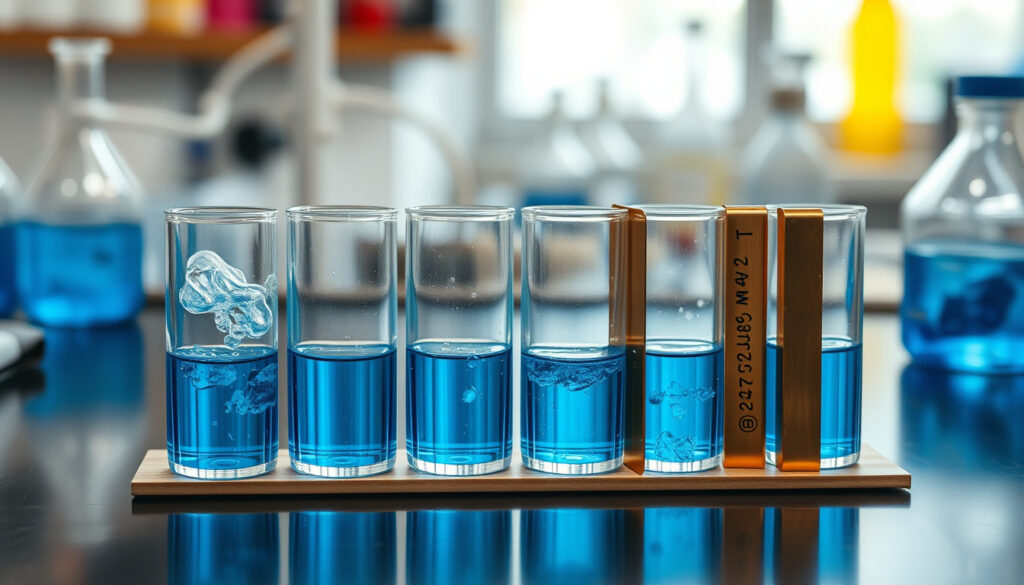
The Royal Society of Chemistry provides a classic classroom demonstration: zinc in copper(II) sulfate solution displaces copper, turning the solution from blue to colourless and depositing copper. Copper in zinc sulfate leaves the solution unchanged — copper is less reactive than zinc. This simple test yields the same ordering that scientists have established.
Observing reactions with water and acids
Reactivity also reveals itself when metals meet water or acids. According to BBC Bitesize, the most reactive metals (potassium, sodium, calcium) react with cold water. Magnesium reacts slowly with cold water but vigorously with steam. Aluminium, zinc, and iron react only with steam or acids. Copper, silver, and gold show no reaction with water or dilute acids at all.
Using the electrochemical series
The electrochemical series ranks metals and other elements by their standard electrode potentials. The Encyclopaedia Britannica (reference publisher) explains that the reactivity series is largely consistent with these potentials, though the experimental conditions (temperature, concentration, surface oxide layers) can cause slight deviations.
A student performing a single displacement reaction in a lab can reproduce the entire reactivity series from scratch — no theoretical calculations required.
What is the easy trick for the reactivity series of metals?
Popular mnemonics for the reactivity series
- “Please Stop Calling Me A Careless Zebra Instead Try Learning How Copper Saves Gold” — maps to Potassium, Sodium, Calcium, Magnesium, Aluminium, Carbon, Zinc, Iron, Tin, Lead, Hydrogen, Copper, Silver, Gold.
- “Mother-In-Law” — groups reactivity zones rather than listing each metal.
- First-letter acronyms that fit a memorable sentence.
The long mnemonic is shared on study platforms like askIITians (student forum) and Scribd (document sharing platform). Some teachers prefer shorter versions — but the key is to attach each metal’s symbol to a familiar word or image.
Creating your own mnemonic
If the standard phrase doesn’t stick, make your own. Pick a sentence where the first letters match the series. For example: “Potassium So Can Manage All Carbon Zircons In Tin Lead? Hydrogen Copper Silver Gold!” The Achievers Dream (tuition centre) suggests building personalised mnemonics by linking each metal to a personal story.
Using flashcards and repetition
Write the series on flashcards with the metal on one side and its reactivity group on the other. Quizzing yourself or studying with a partner (often available through SLS Student Learning Space) can lock the sequence into long-term memory.
How to tell which metal is the most reactive?
Comparing reactions with water
- Potassium: violent reaction, catches fire.
- Sodium: very fast, flame visible.
- Calcium: steady reaction, hydrogen bubbles released.
- Magnesium: very slow reaction with cold water, but rapid with steam (BBC Bitesize).
The speed and intensity of the reaction with cold water directly indicates reactivity. Any metal that reacts with cold water ranks above those that don’t.
Comparing reactions with dilute acids
Metals above hydrogen in the series — from potassium down to lead — typically displace hydrogen from dilute acids, producing a salt and hydrogen gas (Encyclopaedia Britannica). The vigour of bubbling gives a rough order: potassium and sodium produce intense bubbling; zinc and iron produce a steady stream; copper and below produce none.
Using the reactivity series chart
The chart below summarises the hierarchy. For students in Singapore, resources like science tuition programmes can turn this chart into hands-on experiments.
| Metal | Reaction with cold water | Reaction with steam | Reaction with dilute HCl |
|---|---|---|---|
| Potassium | Violent, ignites | — | Explosive |
| Sodium | Very fast, flame | — | Very vigorous |
| Calcium | Steady, bubbles | — | Vigorous |
| Magnesium | Very slow | Fast | Fast |
| Aluminium | None (oxide layer) | Reacts slowly | Reacts after oxide removal |
| Zinc | None | Reacts | Steady |
| Iron | None | Reacts slowly | Slow |
| Copper | No reaction | No reaction | No reaction |
| Silver | No reaction | No reaction | No reaction |
| Gold | No reaction | No reaction | No reaction |
The pattern: reactivity drops sharply from potassium to gold. Metals above hydrogen react with acids; those below hydrogen do not.
What are the 7 types of chemical reactions?
While the reactivity series focuses on single displacement, it helps to see where that fits among the seven major reaction types.
Synthesis reactions
- Two or more substances combine to form a single product, e.g., 2H₂ + O₂ → 2H₂O.
Decomposition reactions
- A compound breaks down into simpler substances, e.g., 2H₂O → 2H₂ + O₂.
Single displacement reactions
- A more reactive metal displaces a less reactive one: Zn + CuSO₄ → ZnSO₄ + Cu (Royal Society of Chemistry).
Double displacement reactions
- Two compounds exchange ions, e.g., NaCl + AgNO₃ → AgCl + NaNO₃.
Combustion reactions
- A substance reacts with oxygen, releasing heat and light, e.g., CH₄ + 2O₂ → CO₂ + 2H₂O.
Acid-base reactions
- Acid + base → salt + water, e.g., HCl + NaOH → NaCl + H₂O.
Redox reactions
- Electron transfer occurs. Single displacement is always redox because one metal loses electrons and another gains them.
Single displacement reactions are directly tied to the reactivity series — without it you cannot predict whether a displacement will happen.
How to experimentally determine reactivity using displacement reactions
- Prepare metal salt solutions: Copper(II) sulfate, zinc sulfate, iron(II) sulfate, etc.
- Clean metal strips: Remove any oxide layer with sandpaper for reliable contact.
- Place each metal in a different salt solution: For example, add a zinc strip to copper(II) sulfate solution.
- Observe for 2–5 minutes: A colour change, gas bubbles, or solid deposit indicates a displacement occurred.
- Record results in a table: Mark “displacement” or “no displacement” for each pair.
- Order by displacement count: The metal that displaces the most others is the most reactive; the one that never gets displaced is the least reactive (Royal Society of Chemistry).
This classroom experiment consistently reproduces the standard reactivity series. For further guided practice, students can access SLS Student Learning Space to view video demonstrations.
What we know and what remains uncertain
Confirmed facts
- Potassium is more reactive than sodium.
- Gold is the least reactive common metal.
- The reactivity series is based on experimental observations (Royal Society of Chemistry).
What’s still unclear
- The exact order of aluminium vs. zinc can vary because aluminium’s protective oxide layer interferes in some tests (Royal Society of Chemistry).
- Whether carbon and hydrogen should be listed alongside metals is a curriculum choice, not a settled scientific fact.
- The effectiveness of mnemonics differs by learner; no single mnemonic works for everyone (Achievers Dream (tuition centre)).
- Some teaching materials include platinum as even less reactive than gold, but the school series often stops at gold.
Perspectives from chemistry education
“The reactivity series is an empirical ranking of metals by how readily they react, and it is commonly used to predict displacement reactions and reactions with water and acids.”
— Royal Society of Chemistry (educational charity) (source)
“A metal’s reactivity is related to its tendency to lose electrons and form positive ions.”
— BBC Bitesize GCSE Chemistry (UK curriculum resource) (source)
Both sources emphasize that the series is not theoretical but derived from visible reactions — something any student can confirm in a lab.
For any student tackling GCSE, O-level, or Class 10 chemistry, the reactivity series is more than a memorization task — it’s the key to understanding why some metals corrode, why gold stays shiny, and how industrial extraction works. The choice is clear: learn the order, practice displacement experiments, and you’ll have a chemical insight that lasts beyond the exam.
Frequently asked questions
Why is potassium more reactive than lithium?
Potassium is in Group 1 below lithium. Its valence electron is further from the nucleus, so it is more easily lost. The lower the ionization energy, the higher the reactivity.
Can the reactivity series predict if a reaction will occur?
Yes. A metal will displace any metal below itself in the series from a compound. The Royal Society of Chemistry confirms this rule is one of the series’ main uses.
What is the reactivity series of non-metals?
Non-metals are not typically arranged in a reactivity series like metals. However, a similar concept exists for halogens (fluorine most reactive, iodine least reactive) based on electron gain.
How does the reactivity series relate to the electrochemical series?
The electrochemical series lists standard electrode potentials. The order of metals in the reactivity series largely mirrors these potentials, though the reactivity series is simplified for classroom use (Encyclopaedia Britannica).
Why is carbon included in the reactivity series?
Carbon is included because it can reduce metal oxides (e.g., zinc oxide) during extraction. Any metal below carbon in the series can be extracted by carbon reduction; metals above carbon require electrolysis.
How is the reactivity series used in metal extraction?
Metals high in the series (e.g., aluminium) are extracted by electrolysis because they hold onto oxygen too strongly for carbon to displace. Metals lower down (e.g., iron, zinc) can be extracted using carbon in a blast furnace.
What is the reactivity series of metals for class 8?
Class 8 curricula typically present a simplified list: potassium, sodium, calcium, magnesium, aluminium, zinc, iron, lead, hydrogen, copper, silver, gold — often with carbon omitted.
Where can I find a reactivity series of metals worksheet?
Many educational websites offer printable worksheets. For example, the Royal Society of Chemistry provides classroom resources with tables and questions.
More related posts
 How to Check Your Polling Station Queue in Ireland
 Watch Movies Online Free: Best Sites & Apps Guide
 Sri Mariamman Temple Singapore – History, Dress Code & Visitor Guide
 West Indies Cricket Team – History, Achievements and Leaders
 Lao Wei Dao Sha Guo Bao: Menu, Outlets, Reviews Singapore
 Jewellery Store Marina Bay Sands: Luxury Brands & Hours
 Hi, Who Are You? Meaning, Answers, and Song Lyrics Explained
 Halal Restaurants in Singapore: Best Guide & Lists
