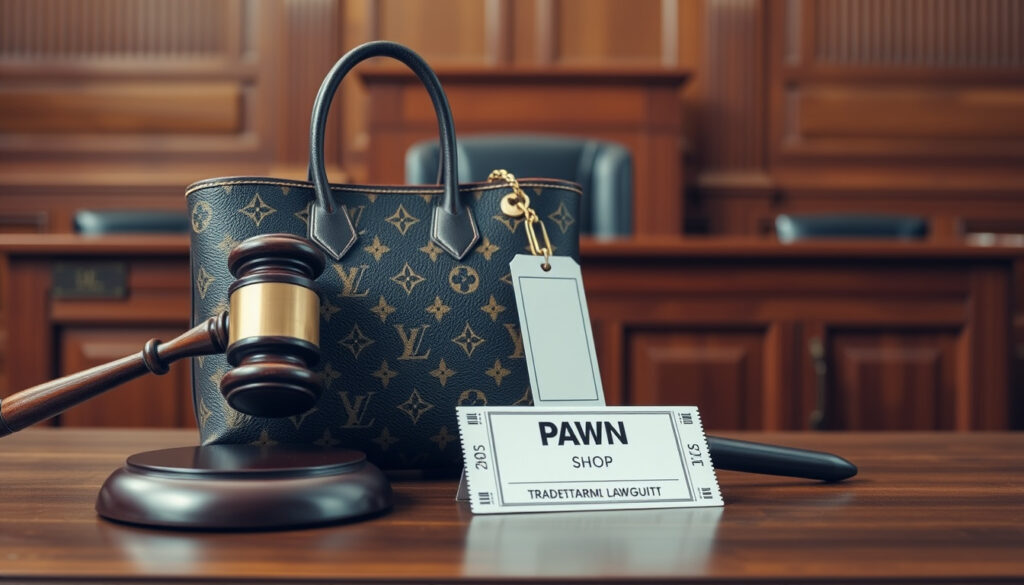
Louis Vuitton Sues ValueMax: Trademark Lawsuit Explained
Few things catch a luxury brand’s attention like a pawnshop selling jewelry that echoes its signature design. When Louis Vuitton discovered two such items at a ValueMax store in Singapore’s Yishun district in mid-2024, it didn’t just raise concerns — it filed a trademark infringement lawsuit in the Singapore High Court.
Lawsuit filing date: December 2025 ·
Court: Singapore High Court ·
Defendant: ValueMax Retail (SGX-listed) ·
Claims: Trademark infringement and passing off ·
Alleged product: Jewelry items sold by ValueMax
Quick snapshot
- Louis Vuitton filed suit in Singapore High Court in December 2025 (The Business Times)
- Dispute centers on two jewelry items sold at Yishun Street 22 store (The Business Times)
- ValueMax denies infringement and passing off (The Business Times)
- ValueMax’s official defense strategy beyond initial denial
- Specific monetary damages Louis Vuitton is seeking
- Outcome or timeline of court proceedings
- July–August 2024: Alleged infringing items offered at Yishun store (The Business Times)
- December 2025: Lawsuit filed in Singapore High Court (The Business Times)
- February 2026: Case settled and discontinued (The Express Tribune)
- Case has been amicably settled as of February 2026 (The Express Tribune)
- No admission of liability by ValueMax Retail (The Express Tribune)
- ValueMax expects no material impact on operations (MiniChart Singapore)
Four key facts, one pattern: the case highlights how luxury brands view even pawnshop resellers as threats to trademark integrity.
The table below summarizes the core legal dynamics.
| Label | Value |
|---|---|
| Legal claims | Trademark infringement and passing off |
| Defendant response | Denied infringement; items were unredeemed pawned goods (MiniChart Singapore) |
| Similar previous suits | Louis Vuitton sued Maryland Live! Casino over trademark use |
| Industry reaction | Discussed on Reddit and luxury news forums |
The pattern: a luxury giant with global resources versus a local pawnshop chain — an asymmetry that highlights the lengths brands go to protect their intellectual property.
What Is the Louis Vuitton ValueMax Lawsuit?
Background of the legal action
- Louis Vuitton Malletier filed a writ of summons in the Singapore High Court in December 2025 against ValueMax Retail Pte Ltd, a wholly owned subsidiary of SGX-listed ValueMax Group (The Business Times).
- The dispute centers on two pieces of jewelry sold or offered for sale by ValueMax Retail (The Business Times).
- Louis Vuitton alleged the disputed jewelry was offered at ValueMax Retail’s Yishun Street 22 store in July and August 2024 (The Business Times).
The claims include trademark infringement and passing off, meaning Louis Vuitton argues the items misled customers into believing they were associated with the brand. ValueMax Retail denied both allegations, pointing out that the symbols on the items were neither identical nor similar to any Louis Vuitton marks (The Business Times).
A pawnshop that typically sells second-hand goods at a fraction of luxury retail prices is being treated as a direct competitor by one of the world’s most exclusive fashion houses. The claim suggests Louis Vuitton sees brand dilution risk even in the secondary market.
The implication: this case tests whether a pawnbroker’s routine sale of unredeemed items can constitute trademark infringement when the items bear any resemblance to a protected design.
Key parties involved
- Plaintiff: Louis Vuitton Malletier, the French luxury fashion house and a flagship brand of LVMH Moët Hennessy Louis Vuitton SE.
- Defendant: ValueMax Retail Pte Ltd, a wholly owned subsidiary of ValueMax Group, which is listed on the Singapore Exchange (SGX).
- Court: Singapore High Court, the country’s superior court handling intellectual property disputes.
ValueMax said the gold charm and earrings in question were unredeemed pawned items acquired through separate sources during regular business operations (MiniChart Singapore). The company stated the litigation would not have any material impact on its business operations or financial statements for the year ending 31 December 2025 (MiniChart Singapore).
Why Is Louis Vuitton Suing ValueMax?
Alleged trademark infringement on jewelry
- Louis Vuitton claimed the jewelry bore signs identical or similar to one or more of its registered marks (The Business Times).
- A Vietnamese business report said Louis Vuitton accused ValueMax Retail of infringing trademark rights and misrepresenting the items as LV products or suggesting an economic association with the brand (VnExpress International).
- ValueMax Retail denied infringing Louis Vuitton’s trademarks and denied passing off, stating the symbols on the items were neither identical nor similar to any Louis Vuitton marks (The Business Times).
Louis Vuitton sought statutory damages for the alleged infringements (VnExpress International). Singapore statutory damages for such claims are capped at S$100,000 per type of goods or services and S$1 million in total unless actual losses above that amount are proven (VnExpress International).
The S$1 million statutory cap in Singapore means Louis Vuitton’s potential recovery is limited unless it can demonstrate actual losses exceeding that threshold — a high bar when the allegedly infringing items are pawnshop jewelry.
The trade-off: Louis Vuitton must prove consumer confusion, while ValueMax argues the items were ordinary pawnshop goods with no deliberate brand association.
Louis Vuitton’s argument of direct competition
- Louis Vuitton stated that ValueMax Retail is a direct competitor (The Business Times).
- Louis Vuitton also demanded delivery and forfeiture of goods and materials plus full disclosure of information connected to the alleged counterfeits (VnExpress International).
This is the most striking element of the case: a luxury house that sells handbags for thousands of dollars classifying a pawnshop as a competitor. The argument suggests that any sale of items bearing LV-like designs — even in a secondary market context — competes with Louis Vuitton’s own product lines and licensing.
Is There a Lawsuit Against Louis Vuitton?
Separate cases: Maryland Live! Casino lawsuit
- Louis Vuitton sued Maryland Live! Casino over unauthorized use of its trademarks in 2022 (approx.) (The Business Times).
- In that case, Louis Vuitton was the plaintiff, not the defendant — consistent with its role as an aggressive trademark enforcer.
Louis Vuitton is almost always the party bringing suit, not defending one. The brand has a well-documented history of filing trademark infringement actions globally, from casinos in the United States to pawnshops in Singapore. No major lawsuit is currently active against Louis Vuitton itself.
Overview of litigation involving Louis Vuitton
- Louis Vuitton maintains active trademark enforcement globally, with cases spanning multiple jurisdictions (The Business Times).
- The brand is plaintiff, not defendant, in the vast majority of its legal actions.
The pattern: Louis Vuitton’s legal strategy is offensive, not defensive. It files suits to protect its intellectual property, not to respond to challenges against it.
Is Louis Vuitton Losing Popularity or in Debt?
Brand popularity trends
- Louis Vuitton remains a top luxury brand globally, consistently ranking among the most valuable fashion brands in the world.
- LVMH, the parent company, reported strong revenue growth in recent years, with no signs of declining brand equity.
The short answer is no. Louis Vuitton’s brand strength is not in question. The lawsuit against ValueMax is a routine trademark enforcement action, not a sign of desperation or decline. The brand continues to open new stores, release collections, and maintain its position at the top of the luxury market.
Financial health of LVMH
- LVMH Moët Hennessy Louis Vuitton SE is the world’s largest luxury goods conglomerate.
- The group reports strong revenue and profit margins, with no existential debt crisis.
There is no evidence that Louis Vuitton or its parent company LVMH faces financial distress. The lawsuit against ValueMax is a standard intellectual property protection measure, not a reflection of financial trouble. The brand’s legal enforcement budget is a fraction of its marketing spend, and the case is unlikely to have any material impact on LVMH’s balance sheet.
The catch: the narrative that a luxury brand suing a pawnshop signals weakness is misleading. In reality, it signals the opposite — a brand with resources to enforce its trademarks wherever it sees a threat.
Timeline
- 2022 (approx.): Louis Vuitton sues Maryland Live! Casino over unauthorized trademark use.
- July–August 2024: Allegedly infringing jewelry items offered at ValueMax Retail’s Yishun Street 22 store (The Business Times).
- December 2025: Louis Vuitton files lawsuit against ValueMax Retail in Singapore High Court.
- Early 2026: Case conference takes place (VnExpress International).
- 12 February 2026: Parties reach amicable settlement; lawsuit formally discontinued (The Express Tribune).
- Ongoing: Louis Vuitton maintains active trademark enforcement globally.
Clarity check
Confirmed facts
- Louis Vuitton filed a lawsuit against ValueMax Retail in December 2025 (The Business Times)
- The case involves allegations of trademark infringement and passing off
- Louis Vuitton considers ValueMax a direct competitor (The Business Times)
- The case was settled amicably on 12 February 2026 (The Express Tribune)
- ValueMax denied infringement and said items were unredeemed pawned goods (MiniChart Singapore)
What’s unclear
- ValueMax’s official defense strategy beyond initial denial
- Specific monetary damages sought by Louis Vuitton
- Whether any admission of liability was part of the settlement
- Full details of the settlement terms
- How the case might influence future luxury brand enforcement against resellers
Voices from the case
Louis Vuitton accused ValueMax Retail of infringing trademark rights and misrepresenting the items as LV products or suggesting an economic association with the brand.
— Reported by VnExpress International
ValueMax said the gold charm and earrings in question were unredeemed pawned items acquired through separate sources during regular business operations.
— Statement from ValueMax Group, reported by MiniChart Singapore
The parties reached an amicable settlement and the lawsuit was formally discontinued.
— Reported by The Express Tribune
Louis Vuitton alleged the disputed jewelry was offered at ValueMax Retail’s Yishun Street 22 store in July and August 2024.
— Reported by The Business Times
The case was resolved before a full trial could test the novel question of whether a pawnshop selling second-hand goods can be a direct competitor to a luxury brand. The settlement means that question remains unanswered, at least for now.
For ValueMax, the outcome is a practical win: no admission of liability, no material impact on operations, and the lawsuit withdrawn. For Louis Vuitton, the settlement achieves its immediate goal of removing the allegedly infringing items from the market without the cost and uncertainty of a trial. For the broader luxury resale market in Singapore, the implication is clear: brands are watching, and the line between legitimate resale and trademark infringement remains blurry.
youtube.com, wipo.int, asiaiplaw.com, youtube.com, elitigation.sg, excellencesg.com, singaporelawwatch.sg, straitstimes.com
Frequently asked questions
What is a passing off claim in trademark law?
Passing off occurs when one party misrepresents their goods or services as being associated with another party’s brand, causing confusion among consumers. It is a common law tort that protects unregistered trademark rights and business goodwill.
How does Louis Vuitton protect its trademark globally?
Louis Vuitton maintains an active trademark enforcement program, filing lawsuits against alleged infringers across multiple jurisdictions. The brand has pursued cases against casinos, resellers, and retailers worldwide, leveraging both registered trademarks and passing off claims.
What types of jewelry did ValueMax allegedly sell?
The dispute centered on two pieces of jewelry — a gold charm and earrings — that Louis Vuitton alleged bore signs identical or similar to its registered marks. ValueMax stated these were unredeemed pawned items acquired through regular business operations.
Can a pawnshop sell luxury brand items legally?
Pawnshops can sell second-hand luxury goods, but they must ensure the items do not infringe on active trademarks. Selling items that bear counterfeit or confusingly similar marks can expose pawnshops to legal liability, even if the items were acquired as unredeemed pawns.
What is the difference between trademark infringement and passing off?
Trademark infringement involves the unauthorized use of a registered trademark, while passing off protects unregistered rights by preventing misrepresentation that causes consumer confusion. Both claims were brought by Louis Vuitton in this case.
How long do trademark lawsuits typically take in Singapore?
Trademark cases in the Singapore High Court can take 12 to 24 months to reach trial, though many are resolved earlier through settlement, as happened in this case. The case was filed in December 2025 and settled by February 2026.
Has Louis Vuitton sued other resellers before?
Yes, Louis Vuitton has a well-documented history of suing retailers and resellers over trademark infringement. Notable cases include the 2022 lawsuit against Maryland Live! Casino and numerous actions against online sellers and physical retailers globally.
What does the settlement mean for ValueMax?
The settlement was reached without any admission of liability by ValueMax Retail. The company previously stated the litigation would not materially impact its business operations or financial statements. The case was formally discontinued on 12 February 2026.
For Singapore’s pawnshop and resale industry, the choice is clear: invest in trademark screening before accepting branded items, or risk becoming the next defendant in a luxury brand’s enforcement campaign.
More related posts
 Weekend Getaway from Singapore: 18 Easy Trips Under 3 Hours
 Decathlon Kallang Opening Hours: 9am-11pm, Not 24/7
 UOB Points to Miles: Conversion Rates & How-To Guide
 Real Madrid vs Man City Standings: Head-to-Head & UCL Table
 Podcasts for Learning English: Best Shows & Routine
 GE Vernova Stock Price Today (GEV): Live Quote & Forecast
 Airport Jobs in Singapore: Changi Openings & Salaries
 100 USD to SGD: Convert US Dollars to Singapore Dollars Rate
