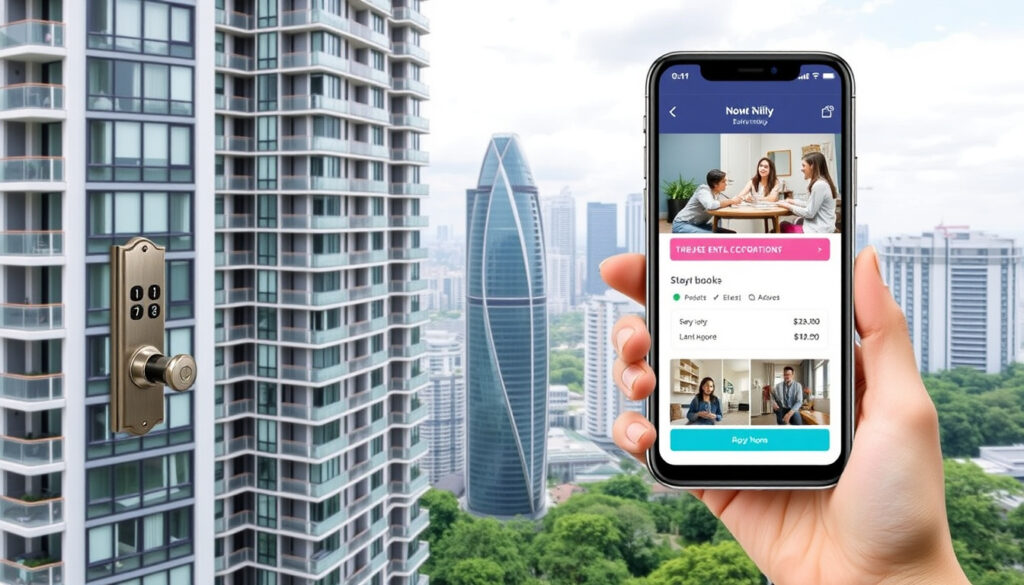
Short Term Rental Singapore: Rules, Options, and Best Platforms
Planning a trip to Singapore and looking for a place to stay for a few weeks? You might be surprised to learn that renting a private apartment for anything less than three months is actually against the law. Singapore’s strict short-term rental regulations mean most visitors end up choosing serviced apartments, co-living spaces, or hotels – and understanding the rules can save you from a hefty fine or a booking that falls through.
Minimum stay in private residential: 3 months (per URA regulations) ·
Minimum stay in serviced apartments: 7 days ·
Short-term rental listings on HomeToGo: thousands
Quick snapshot
- No minimum stay required (Urban Redevelopment Authority (URA), Singapore’s land-use regulator)
- Wide range of price points (Urban Redevelopment Authority (URA), Singapore’s land-use regulator)
- Best for stays under 1 week (Urban Redevelopment Authority (URA), Singapore’s land-use regulator)
- Minimum stay typically 7 days (Cove, co-living research blog)
- Fully furnished with kitchen and laundry (Cove, co-living research blog)
- Ideal for stays of 1 week to 3 months (Cove, co-living research blog)
- Flexible monthly or weekly leases (Cove, co-living research blog)
- All-inclusive rent (utilities, Wi‑Fi)
- Popular with digital nomads and young professionals
- Legal minimum lease of 3 months (WongPartnership, Singapore law firm)
- Often cheaper per month than serviced options (WongPartnership, Singapore law firm)
- Requires a formal tenancy agreement (WongPartnership, Singapore law firm)
Four accommodation types, one key pattern: the shorter your stay, the fewer legal choices you have. Hotels and serviced apartments dominate stays under three months, while private properties only become an option once the lease reaches the 90-day threshold.
| Factor | Detail |
|---|---|
| Legal minimum stay for private residential | 3 months (Urban Redevelopment Authority (URA), Singapore’s land-use regulator) |
| Legal minimum stay for HDB flats | 6 months (non‑owner) or not allowed for short‑term (Figment, local accommodation guide) |
| Short‑term stays (<3 months) allowed only in | Hotels and serviced apartments (URA, Singapore’s land-use regulator) |
| Maximum fine for illegal short‑term renting | SGD 200,000 (WongPartnership, Singapore law firm) |
The pattern is clear: the law draws a bright line at three months. For expats and travelers who stay shorter, serviced apartments and co-living operators fill the gap – but at a premium.
What are the legal restrictions on short term rentals in Singapore?
What is the minimum stay for private residential properties?
- Private residential properties – condominiums, apartments, and landed houses – require a minimum lease of three consecutive months under the Planning Act (Urban Redevelopment Authority (URA)).
- The three-month rule was introduced in May 2017 and applies to any stay shorter than 90 days unless special planning permission is granted (WongPartnership, Singapore law firm).
- If URA approval is sought, proposed conditions include a 90-day annual cap, a maximum of 6 guests per unit, and fire-safety requirements (WongPartnership).
Which accommodation types are exempt from the 3‑month rule?
- Hotels have no minimum stay requirement (URA).
- Serviced apartments, licensed hostels, and serviced residences are legally allowed to accept stays of less than three months, with a typical minimum of 7 days (Cove, co-living research blog).
What are the penalties for illegal short‑term rentals?
- Operating an unapproved short-term rental can lead to a fine of up to S$200,000 under the Planning Act (WongPartnership).
- For continuing offences, an additional daily fine of up to S$10,000 applies (WongPartnership).
- Repeat offenders may face imprisonment of up to 12 months (WongPartnership).
The fines are steep enough that most property owners steer clear of short-term tenants altogether. That’s why the legal market is dominated by operators who are specifically licensed for short stays.
The implication: for stays under three months, your choices are effectively limited to hotels and serviced apartments – and even serviced apartments usually require a minimum of a week.
What short term rental options are available for different durations in Singapore?
What options exist for 1‑week or 2‑week stays?
- Hotels – no minimum stay, book by the night (URA).
- Serviced apartments – most allow stays of 7 days or longer, full kitchens, weekly housekeeping (Cove).
- Co-living spaces – some operators like Cove offer weekly leases for private rooms (Cove).
How to find 3‑month and 6‑month rentals?
- For 3-month stays, private apartments become legal – platforms like HomeToGo (vacation rental aggregator) list thousands of units (HomeToGo).
- For 6‑month stays, HDB flats become an option, but only for non‑owner occupancy with a formal tenancy agreement (Figment, local accommodation guide).
What are the differences between hotels, serviced apartments, and co‑living spaces?
Four accommodation types, one comparison: trade duration for cost and space.
| Type | Minimum stay | Typical monthly cost | Best for |
|---|---|---|---|
| Hotel | None | S$3,000–S$6,000 | Short visits <7 days |
| Serviced apartment | 7 days | S$2,500–S$5,000 | 1 week – 3 months |
| Co‑living space | 7–30 days | S$1,800–S$3,500 | 1 week – 6 months |
| Private apartment (legal lease) | 3 months | S$1,500–S$3,000 | 3+ months, budget |
The trade-off: shorter stays mean paying a premium for flexibility, while committing to three months opens up cheaper private rental options.
How to find cheap short term rentals in Singapore?
Which platforms offer discounted short‑term stays?
- Compare prices across aggregators like CozyCozy (travel booking platform) and HomeToGo (CozyCozy).
- Use the “monthly” filter on co-living sites to see per-night rates for longer stays (Cove).
Are there any budget co‑living options?
- Operators like Cove offer all-inclusive rents from around S$1,800/month for a private room (Cove).
- Figment’s curated list highlights serviced apartments that undercut hotels by 20–30% for monthly bookings (Figment).
How to negotiate lower rates for longer stays?
- Book directly with serviced apartment operators – avoids platform fees (Figment).
- Ask for a weekly or monthly discount – many co-living providers offer 10–15% off the nightly rate for stays over 14 days (Cove).
- Travel during off-peak seasons (February–April, September–October) for lower rates across all categories.
A traveler booking a 28-day stay can save up to 30% by choosing a serviced apartment over a hotel – and another 10% by negotiating directly with the operator instead of using an aggregator.
The takeaway: combining aggregator comparison, direct booking, and off-peak timing can cut costs by up to 40% for stays of two weeks or longer.
What are the best short term rental providers in Singapore?
Which co‑living operators have the best reviews?
- Cove operates multiple locations across Singapore with flexible lease terms and strong online ratings (Cove).
- Figment provides a curated short‑stay guide that includes vetted properties and legal compliance information (Figment).
What are the top‑rated serviced apartments for short stays?
- Treetops Executive Residences and Pan Pacific Serviced Suites are consistently rated highly on CozyCozy (CozyCozy).
- Both offer minimum stays of 7 nights with full amenities.
How do aggregator platforms compare in terms of selection and price?
Two major aggregators, one pattern: each serves a different need.
| Platform | Inventory | Average nightly price (studio) | Minimum stay filter |
|---|---|---|---|
| HomeToGo | Thousands of listings across private & serviced | S$100–S$250 | Yes, adjustable |
| CozyCozy | Hotels + serviced apartments | S$120–S$280 | Yes, by night/week/month |
The implication: for the widest selection, HomeToGo wins; for hotel-style filtering with apartment options, CozyCozy is more intuitive.
Can you rent HDB flats for short term stays in Singapore?
What are the HDB regulations for short‑term leasing?
- HDB flats have a minimum rental period of 6 months for non‑owner occupiers (Figment).
- Stays shorter than 6 months in an HDB flat are generally illegal (Cove).
Are there any exceptions for HDB flats?
- No public exemptions exist for short-term tourist stays. Some owners attempt co‑living arrangements, but these must comply with HDB’s minimum occupation period (Figment).
What are the risks of renting an HDB flat illegally?
- Tenants may be evicted and face legal action; owners risk fines and possible forfeiture of the flat (WongPartnership).
- No insurance coverage for short‑term stays in HDB flats.
HDB flats are effectively off-limits for any trip under six months. Renting one for a 2‑week holiday carries serious legal risk for both tenant and owner.
The conclusion: HDB flats are not a viable short-term rental option for stays under six months.
Clarity check: what’s confirmed and what’s unclear
Confirmed facts
- URA regulations prohibit private residential rentals under 3 months (URA).
- Serviced apartments can rent for a minimum of 7 days (Cove).
- Penalties for illegal short‑term renting include fines up to SGD 200,000 (WongPartnership).
- HDB flats require a 6‑month minimum rental period (Figment).
What’s unclear
- Exact number of illegal short‑term rentals currently operating in Singapore.
- Average nightly price for co‑living spaces (varies widely by location and season).
- Long‑term impact of any recent regulatory changes on the short‑term rental market.
- Actual enforcement rate of short-term rental regulations against individual landlords.
“For those staying less than three consecutive months, available accommodation options include hotels (no minimum stay duration) and serviced apartments (minimum stay 7 days).”
Urban Redevelopment Authority (URA), Singapore’s land-use regulator
“The 3‑month rule is strictly enforced, and many landlords are wary of short‑term tenants.”
Figment, local accommodation guide
For travelers and expats planning a stay in Singapore, the choice is clear: commit to three months to unlock the entire private rental market, or pay a premium for flexibility with serviced apartments and co‑living spaces. For anyone staying less than a week, hotels remain the simplest, most straightforward option. The regulatory framework is unlikely to loosen soon, so planning around the minimum-stay rules is essential.
Frequently asked questions
What is a serviced apartment in Singapore?
A serviced apartment is a fully furnished apartment available for short‑term rental, typically with a minimum stay of 7 days, offering hotel-like amenities such as housekeeping and concierge.
How do I book a short term rental safely?
Use reputable platforms like HomeToGo or CozyCozy, read recent reviews, and confirm the property type meets URA regulations. Avoid paying via wire transfer.
Are short term rentals taxable in Singapore?
Yes – income from short‑term rental is subject to personal income tax for individual landlords. GST may apply if the annual turnover exceeds S$1 million.
Can a foreigner rent a short term apartment in Singapore?
Yes, foreigners can legally rent serviced apartments and co‑living spaces for any duration. For private apartments, the same 3‑month minimum applies.
What is the difference between co‑living and serviced apartments?
Co‑living spaces offer private rooms with shared common areas and all‑inclusive rents, while serviced apartments are self-contained units with private kitchens and living spaces.
Do I need a tenancy agreement for a short term rental?
Yes – even for serviced apartments and co‑living spaces, a formal occupancy agreement is standard. For private rentals over 3 months, a stamped tenancy agreement is legally required.
What should I look for in a short term rental contract?
Check the minimum stay, termination notice period, included utilities, housekeeping frequency, and any restrictions on guests. Ensure the property type is legally allowed for your stay duration.
Related reading: Short Term Rental Singapore: Legal Options & Costs · Owen House by Habyt: Honest Review & Is It Worth It?
More related posts
 English to Tagalog Translation: Best Tools & Grammar Tips
 Brianna Wong and The Closet Lover Closure Story
 Singapore to Ahmedabad Flight: Time, Price, Airlines & Status
 SimplyGo EZ-Link Card – How to Register, Top Up and Use
 AIA HK Share Price – Current Data, Performance & Analysis
 Malaysia Fixed Deposit Rates 2025: Best Bank Comparison
 Kok Kee Wanton Mee – Location, Menu, Prices and Reviews in KL
 2026 Happy New Year Wishes: Timing, Colors, Quotes & More
