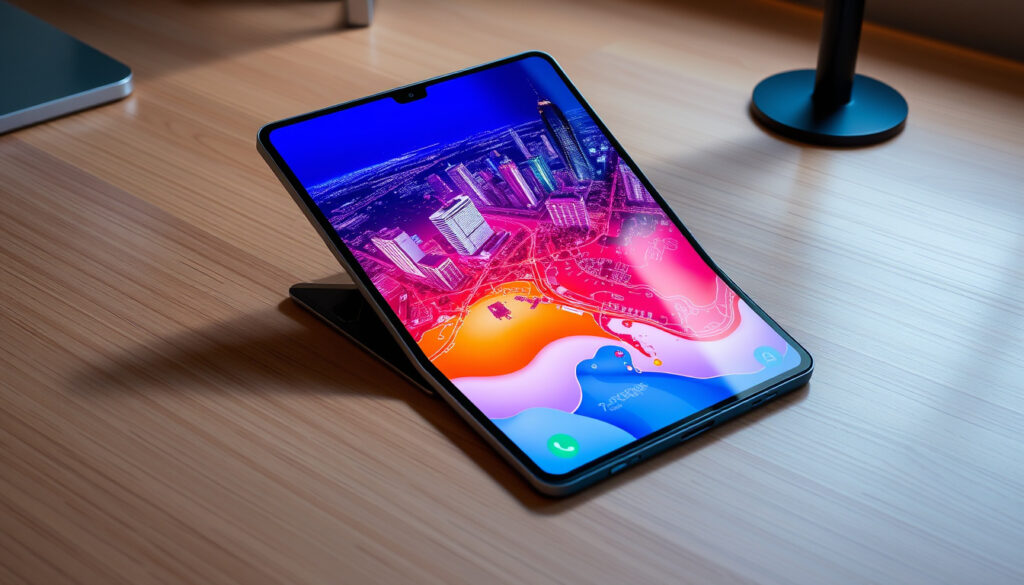
What Is a Z Fold Phone? A Comprehensive Guide to Samsung’s Foldable
If you’ve ever watched someone unfold a phone into what looks like a mini tablet, you’ve probably wondered what the catch is. The Samsung Galaxy Z Fold isn’t just another smartphone — it’s a book-style foldable that trades conventional design for a 7.6-inch flexible display. This guide explains exactly how the Z Fold works, its real-world tradeoffs around durability and cost, and whether the premium price tag makes sense for you.
Main display size: 7.6 inches ·
Cover screen size: 6.2 inches ·
Starting price: $1,899.99 ·
Battery capacity: 4,400 mAh ·
Weight: 253 grams
Quick snapshot
- Uses flexible OLED with ultra-thin glass (Samsung Newsroom)
- Galaxy AI enables real-time translation and photo editing (Samsung Newsroom)
- IP48 dust- and water-resistant on Fold7 (Notebookcheck)
- Whether future models will eliminate the screen crease entirely
- Exact two-year hinge failure rate across all models
- How long the foldable screen stays pixel-perfect under daily use
- 2019: First Galaxy Fold launched
- 2023: Z Fold5 folds flat with new hinge
- 2025: Z Fold7 with 200MP camera arrives
- Screen crease may reduce but likely won’t disappear
- Dust resistance expected to improve toward IP68
- Prices may drop as production scales
Samsung sells a phone that unfolds into a 7.6-inch tablet, yet the very feature that makes it a marvel — the foldable hinge — is the source of most buyer anxiety. The device is simultaneously a productivity powerhouse and a $1,900 question mark about how many folds it can survive.
Here’s how the specs have evolved across generations.
| Specification | Galaxy Z Fold (2019) | Galaxy Z Fold7 (2025) |
|---|---|---|
| Main display size | 7.3 inches | 7.6 inches |
| Cover display size | 4.6 inches | 6.2 inches |
| Water resistance | None | IP48 |
| Weight | 263 grams | 253 grams |
| Battery capacity | 4,380 mAh | 4,400 mAh |
| Processor | Snapdragon 855 | Snapdragon 8 Gen 3 for Galaxy |
| S Pen support | No | Yes |
| Dust resistance | None | IP48 (limited) |
| Starting price | $1,980 | $1,899.99 |
What does the Samsung Z Fold do?
The Samsung Galaxy Z Fold is a book-style foldable smartphone that transforms from a 6.2-inch cover phone into a 7.6-inch tablet when opened. Unlike a traditional slab phone, its flexible OLED display bends at a precision hinge, making it the only mainstream device that fits in a pocket and serves as a mini-tablet on demand (Samsung Newsroom).
What are the key features of the Galaxy Z Fold?
- The main display unfolds to 7.6 inches with a 2176 x 1812 resolution, roughly the size of a Kindle or iPad Mini.
- Galaxy AI on the Fold6 and Fold7 provides real-time call translation, AI-powered photo editing that removes objects, and note summarization (Samsung Newsroom).
- The device supports the S Pen for handwriting and sketching on the foldable display.
- Samsung claims the Infinity Flex Display can withstand over 200,000 folds (Samsung Support Philippines).
How does the Z Fold handle multitasking?
The Z Fold runs Android with Samsung’s One UI overlay, which treats the expanded screen as a multi-window workspace. Users can run three apps simultaneously in split-screen mode, drag-and-drop content between them, and save app pairs as shortcuts for quick launch (Samsung Newsroom). The cover screen shows notifications and quick replies, while the inner display handles full multitasking.
What this means: The Z Fold collapses the need for a separate tablet or laptop for many users. For someone who frequently switches between Slack, Google Docs, and email, the split-screen workflow is genuinely different from a conventional phone — it’s closer to a desktop experience.
How do foldable phone screens work?
Foldable screens rely on flexible OLED technology, where organic compounds emit light on a bendable plastic substrate rather than rigid glass. The display bends around a multi-axis hinge that maintains tension across the folding seam (Samsung Newsroom).
What technology enables the screen to fold?
- A layer of ultra-thin glass (UTG) — about 30 micrometers thick — provides stiffness while allowing the panel to curve.
- Beneath the glass, a flexible OLED panel bends without cracking the pixels.
- The hinge mechanism uses interlocking gears that lock at flat (180°) and folded (0°) positions.
- Sweeper fibers inside the hinge brush dust away from the mechanism (Samsung Support Philippines).
What is the crease on foldable screens?
A visible horizontal crease runs across the fold point on all current Z Fold models. It results from the plastic display layers bending under tension. The crease does not affect touch sensitivity or pixel function, though some users find it distracting when viewing dark content (TechRadar).
The implication: The crease is a trade-off that won’t disappear soon, but the foldable screen’s durability continues to improve.
What are the disadvantages of Samsung fold?
Despite continued improvements, Z Fold buyers face real tradeoffs. Independent tests and user reports point to several weak spots that persist across generations.
What are the most common issues with the Z Fold?
- Screen crease — visible on the main display, especially in bright light.
- Hinge failures — reported after months of use, though failure rates remain unclear (Consumer NZ).
- Dust vulnerability — the Fold7 carries an IP48 rating, meaning dust particles larger than 1mm are blocked, but fine sand and pocket lint can still reach internal components (Notebookcheck).
- Battery life — the 4,400 mAh battery is average for a phone at this price; comparable slab phones like the Galaxy S24 Ultra pack 5,000 mAh (TechRadar).
- Camera quality — the camera system, while solid, trails the Galaxy S Ultra series in low-light performance and zoom capability.
How does the durability compare to regular phones?
Which? (UK consumer group) reported in 2025 that foldables match standard phones in drop tests from pocket height. The Z Fold3 and later models use Armor Aluminum frames and Gorilla Glass Victus on the cover display (Samsung Newsroom). But the inner display remains vulnerable: sand particles can scratch the plastic layer, and replacing that screen costs $500 to $600 without insurance (Notebookcheck).
The trade-off: You get a phone that survives drops as well as an iPhone or Galaxy S. But the display repair bill is roughly twice as high as a conventional flagship, making a case for insurance.
Upsides
- Tablet-sized screen in a pocket-friendly form
- Real multitasking with up to three apps
- Galaxy AI for translation, editing, summarization
- IPX8 water resistance since Fold3
- S Pen support on Fold3 and later
Downsides
- Visible crease on main display
- Vulnerable to sand and dust
- Expensive repairs ($500+ for screen)
- Average battery for price point
- Costs $1,899.99+
Is the Z Fold an Android phone?
Yes, the Samsung Galaxy Z Fold runs Android with Samsung’s One UI 6.x overlay. It has full access to the Google Play Store, Google services, and all standard Android apps (Samsung Newsroom).
What operating system does the Z Fold use?
- Android 14 with One UI 6.1.1 on the Fold6, upgradable to future versions.
- Samsung commits to four major OS updates and five years of security patches for the Z Fold series.
- The multitasking features — split-screen, pop-up windows, app pairs — are built into the Android OS layer.
Does the Z Fold support Google Play?
Absolutely. All Galaxy Z Fold models come with the Google Play Store pre-installed, supporting every Android app. The cover and main displays adapt layouts automatically, though some apps appear stretched on the 7.6-inch inner screen if not optimized for foldables.
Why this matters: Buyers worried about app compatibility can rest easy. The Z Fold runs the same Android ecosystem as any Samsung or Google Pixel phone. The only catch is that a handful of apps — usually games and social media — haven’t optimized for the unfolded aspect ratio.
Why is the Samsung Z Fold so expensive?
The $1,899.99 starting price puts the Z Fold in a category of its own. Here’s what buyers pay for.
What makes the Z Fold’s price so high?
- Flexible OLED + UTG — the foldable display panel costs roughly 2.5 to 3 times more to manufacture than a standard smartphone screen.
- Multi-axis hinge — the hinge assembly includes dozens of interlocking parts, sweeper fibers, and gear mechanisms that require precision assembly.
- Premium materials — Armor Aluminum frame, Gorilla Glass Victus cover, and IPX8 sealing add to the bill of materials (Samsung Newsroom).
- Low production volumes — foldables sell roughly 15-20 million units annually versus 200+ million slab smartphones, keeping per-unit costs high.
- R&D amortization — Samsung invested billions in foldable display R&D over a decade, and those costs are recovered through premium pricing.
Is the Z Fold worth its price?
For professionals who multitask on the go — editors, analysts, real estate agents, travelers — the Z Fold replaces a phone and a tablet, potentially saving carrying two devices. For casual users who mostly scroll social media and take photos, a standard flagship at half the price delivers the same core phone experience.
The pattern: You’re paying a ~$700 to $900 premium over a Galaxy S24 Ultra for the folding mechanism and flexible display. Whether that premium makes sense depends entirely on whether the tablet-in-pocket workflow saves you time every day.
Timeline: The Galaxy Z Fold series
- — Samsung launches the first Galaxy Fold, a book-style foldable with a 7.3-inch display and $1,980 price tag.
- — Galaxy Z Fold2 released with a larger cover screen (6.2 inches) and improved hinge.
- — Galaxy Z Fold3 introduces S Pen support and IPX8 water resistance (Samsung Newsroom).
- — Galaxy Z Fold4 refines the camera system and multitasking software.
- — Galaxy Z Fold5 features a new hinge that folds completely flat, reducing the gap between halves.
- — Galaxy Z Fold6 launches with a lighter frame (239 grams) and Galaxy AI capabilities.
- — Galaxy Z Fold7 arrives with a 200MP camera, IP48 dust resistance, and continued AI enhancements (Notebookcheck).
Clarity check: What’s confirmed and what’s not
Confirmed facts
- The Z Fold uses a flexible OLED panel with ultra-thin glass for protection (Samsung Newsroom).
- The Fold7 carries an IP48 rating for dust and water resistance (Notebookcheck).
- The display is rated for over 200,000 folds (Samsung Support Philippines).
What’s unclear
- Whether future models will eliminate the crease entirely.
- The exact failure rate of foldable hinges over two years of daily use.
- How long the foldable screen remains pixel-perfect under normal wear.
- Samsung’s offer of a one-time reduced-cost screen replacement for Fold3 and later models – availability and terms vary.
“The Galaxy Z Fold7 continues to set high durability standards for foldable phones, but the inner display remains vulnerable to scratches from sand and pocket debris.”
— Notebookcheck, 2025
“Foldable phones are as tough as standard phones in everyday drop and mishap testing. The one big weakness is dust ingress around the hinge.”
— Which?, October 2025
“Galaxy AI transforms the way you use a foldable — real-time call translation, AI photo editing, and note summarization that actually works.”
— Samsung Newsroom
The Z Fold series has evolved from a proof-of-concept in 2019 to a refined device that addresses many early criticisms. Yet the central tension remains: a foldable screen is a marvel of engineering, but it’s also a liability that can’t be fully resolved until the crease disappears and dust protection matches traditional slabs.
For the Singapore buyer considering a $1,899.99 Galaxy Z Fold7, the choice is clear: if your daily workflow involves juggling documents, chats, and media on the move, the foldable screen pays for itself in convenience. If you primarily use your phone for messaging, browsing, and photos, a standard flagship like the Galaxy S24 Ultra offers better camera performance, longer battery life, and lower repair risk at a similar or lower price.
By 2026, two things could shift the equation: dust ratings reaching IP68, which would remove the biggest remaining durability gap, and price drops as foldable production scales. Buyers who can wait should — but anyone who needs a tablet-sized canvas in their pocket today already has a clear winner.
samsung.com, youtube.com, techradar.com, drfone.wondershare.com, youtube.com, image-us.samsung.com, insights.samsung.com, alibaba.com, which.co.uk, youtube.com
Frequently asked questions
Can the Samsung Z Fold be used with one hand?
The cover screen (6.2 inches) is usable one-handed for quick tasks. The unfolded 7.6-inch display requires two hands for most operations.
Does the Z Fold support 5G?
Yes, all Galaxy Z Fold models from the original Fold onward support 5G connectivity (sub-6GHz and mmWave on some models).
What colors is the Galaxy Z Fold available in?
Color options vary by generation. Recent models like the Fold7 offer Phantom Black, Cream, and Gray, with online exclusives like Blue and Green.
How do I clean the foldable screen safely?
Samsung recommends wiping the inner display with a soft, lint-free microfiber cloth. Do not use alcohol-based cleaners, as they can damage the protective layer (Samsung Support Philippines).
Is the Z Fold waterproof?
The Z Fold3 and later models have an IPX8 rating, meaning they survive submersion in up to 1.5 meters of fresh water for 30 minutes. They are not fully dust-resistant (Samsung Support Philippines).
Does the Z Fold work with wireless charging?
Yes, all Galaxy Z Fold models support Qi wireless charging and Wireless PowerShare for charging accessories.
Can I use a regular screen protector on the foldable screen?
No. The inner display comes with a pre-installed protective layer that should not be removed. Using a non-Samsung-approved screen protector can damage the foldable panel. Samsung recommends using only authorized repair services for screen protection.
More related posts
 Digital Marketing Jobs in Singapore: 2026 Salaries & Openings
 Liver Cancer Doctor Singapore: Top Specialists & Hospitals
 Myles Lewis-Skelly: Background, Suspension, Stats & Name Origin
 Red Dot United Manifesto: Key GE2025 Policies Explained
 Is There Fireworks Tonight in Singapore? Guide to Shows 2025
 Fire at Hong Lim Food Centre: Jan 2026 Incident & Hawker’s Story
 Union Bank of India: Ownership, Type, Minimum Balance & Safety
 Best Time to Visit Shanghai: Month-by-Month Guide
