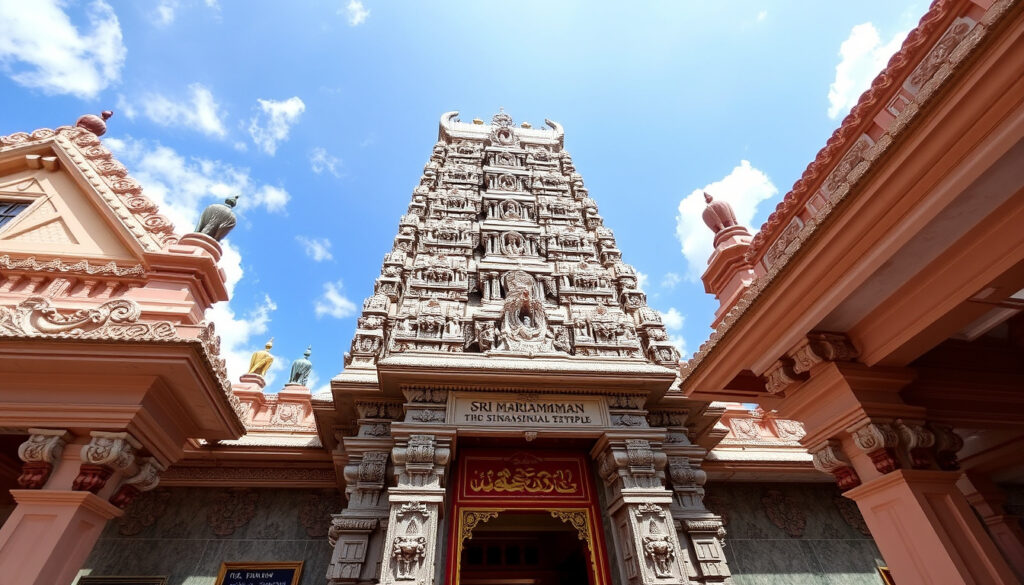
Sri Mariamman Temple Singapore – History, Dress Code & Visitor Guide
The colourful five-tiered gopuram of Sri Mariamman Temple is a striking Chinatown landmark, but its true significance lies in its founding in 1827 as Singapore’s oldest Hindu temple. Built by early Indian settlers, it remains a living centre of worship and community nearly 200 years later.
Year Built: 1827 · Location: 244 South Bridge Road, Chinatown · Architectural Style: Dravidian · Status: National Monument of Singapore · Entry Fee: Free · Operating Hours: 6:00am–12:00pm, 6:00pm–9:00pm
Quick snapshot
- Founded in 1827 as Singapore’s first Hindu temple (National Library Board Singapore, Singapore’s national heritage agency)
- Declared a national monument in 1973 (National Library Board Singapore) (National Library Board Singapore, Singapore’s national heritage agency)
- Exact identity of the original architect remains unknown (National Library Board Singapore) (National Library Board Singapore)
- Precise details of the earliest wood-and-attap structure before expansions (National Library Board Singapore)
- 1827: Temple founded by Indian settlers (National Library Board Singapore)
- 1925: Five-tiered gopuram replaces original three-tiered structure (National Library Board Singapore)
- Ongoing restoration and community events (National Library Board Singapore) (BiblioAsia, heritage publication by NLB)
- Growing visitor interest as a heritage tourism site (BiblioAsia, heritage publication by NLB)
Six key facts, one pattern: the temple’s story is one of continuous adaptation—from a simple wood-and-attap building to a majestic Dravidian monument that has stood for nearly two centuries.
| Label | Value |
|---|---|
| Year founded | 1827 |
| Architectural style | Dravidian |
| Primary deity | Mariamman (goddess of rain and healing) |
| Address | 244 South Bridge Road, Singapore 058793 |
| National monument status | Yes, since 1973 |
| Operating hours | 6:00am–12:00pm, 6:00pm–9:00pm; Fri closes 9:15pm |
What is the history of Sri Mariamman Temple in Singapore?
Who built the Sri Mariamman Temple?
The temple was founded in 1827 by Naraina Pillai (also spelled Narayana Pillay), a government clerk who arrived in Singapore with Stamford Raffles in 1819. Together with other community leaders, he secured a site along South Bridge Road for the first Hindu place of worship in the settlement (National Library Board Singapore, Singapore’s national heritage agency). An Indian landowner, Seshasalam Pillai, later donated part of his land in 1831 to enlarge the compound (National Library Board Singapore).
When was the temple originally constructed?
The first structure on the site was a wood-and-attap building, completed in 1827 (National Library Board Singapore). It was rebuilt with bricks in 1843, and the oldest sections of the current brick structure date from that year (National Library Board Singapore). Significant expansions followed in 1862, and in 1925 the original three-tiered raja gopuram was replaced by the present five-tiered tower (National Library Board Singapore). The temple was officially gazetted as a national monument in 1973—the first Hindu religious site in Singapore to receive that status (National Library Board Singapore).
The temple’s timeline shows how early Indian migrants turned a small thatched shelter into a permanent brick-and-mortar institution—well before many other religious buildings in the colony were even started.
The implication: Sri Mariamman Temple is not just a place of worship but a physical record of the Indian diaspora’s struggle to establish roots in a new trading port. Its early expansions reflect a growing community that was determined to preserve its cultural identity.
What is the dress code for Sri Mariamman Temple Singapore?
Is it okay to wear jeans to the temple?
Yes, jeans and t-shirts are generally acceptable, as long as they are modest—shoulders and knees should be covered (National Library Board Singapore, Singapore’s national heritage agency). Footwear must be removed before entering the temple courtyard. The same rule applies to all visitors, regardless of faith.
Is it appropriate to wear jeans and t-shirts when visiting temples?
Traditional Indian attire like saris or kurta pyjamas is welcome but not required. The key is to dress respectfully. Many visitors find that covering up and removing shoes is a simple way to show reverence, and the temple provides shoe racks at the entrance. The dress code is enforced by temple staff, though it is generally applied with common sense (National Library Board Singapore). If you’d wear it to a formal event, you’re probably fine. For other venue dress codes, see our guide to Garibaldi Italian Restaurant & Bar: Dress Code, Menu, History.
For travellers used to casual attire, the modest dress rule is a small inconvenience—but it ensures that the temple remains a sacred space, not a tourist attraction first.
The pattern: the dress code is less about strict cultural rules and more about common courtesy. If you’d wear it to a formal event, you’re probably fine.
Is the Sri Mariamman Temple free?
Are there any charges for entering the temple?
Entry to Sri Mariamman Temple is free of charge for all visitors (National Library Board Singapore, Singapore’s national heritage agency). There are no ticket booths or entrance fees, making it accessible to everyone regardless of budget.
Are donations accepted?
Donations are accepted but entirely voluntary. Visitors can drop cash into donation boxes located near the main shrine. Special ceremonies, such as weddings or fire-walking festivals, may involve fees for participants, but general sightseeing and prayer remain free (National Library Board Singapore).
For budget-conscious travellers, this is a rare free attraction in expensive Singapore. The lack of an entry fee removes a barrier to cultural exploration.
The catch: while entry is free, the temple’s remote location in Chinatown means you’ll likely spend money on transport or nearby food—but that’s hardly a downside.
What is the story behind Mariamman?
Who is Mariamman?
Mariamman is a Hindu goddess of rain, fertility, and healing, widely worshipped in South India, particularly in the Tamil Nadu region (BiblioAsia, heritage publication by NLB). She is considered a village goddess who protects against disease and brings prosperity. The Sri Mariamman Temple in Singapore is dedicated to her, and her image is the central focus of the main shrine.
What does Mariamman represent?
Mariamman’s worship is deeply tied to agricultural cycles and the monsoon season. Early Indian migrants brought her devotion to Singapore, and the temple became a focal point for the Tamil community. The goddess is also associated with powerful rituals, including fire-walking and other acts of devotion that are still performed at the temple during the annual timiti (fire-walking) festival (BiblioAsia, heritage publication by NLB).
A goddess of rain and healing is housed in a temple that replaced its thatched roof with solid brick—a subtle metaphor for the migrant community’s transition from vulnerability to stability.
The implication: Mariamman’s story is a bridge between rural South Indian traditions and urban Singaporean life. The temple keeps her ancient rituals alive in a modern, high-rise city.
What is the oldest temple in Singapore?
How old is Sri Mariamman Temple?
Sri Mariamman Temple was completed in 1827, making it the oldest Hindu temple in Singapore (National Library Board Singapore, Singapore’s national heritage agency). It predates other major religious sites like the Thian Hock Keng Temple (built 1840) and the Sultan Mosque (built 1824 but completed later).
Is Sri Mariamman Temple the oldest Hindu temple in Singapore?
Yes, it is the oldest Hindu temple in Singapore, and it was the first Hindu religious site to be declared a national monument in 1973 (National Library Board Singapore). No other Hindu temple in the country has a longer continuous history.
For history buffs, the temple’s age is a rare asset: it stands as a direct link to the earliest days of Indian settlement in Singapore, when the island was still a fledgling British port.
The pattern: being the oldest gives the temple a unique status, but it also means it has weathered nearly 200 years of urban change. Its survival shows community stewardship.
Timeline
- 1827 – Temple built by Indian settlers along South Bridge Road (National Library Board Singapore)
- 1843 – Major expansion and renovation, brick structure replaces wood (National Library Board Singapore)
- 1862 – Further reconstruction with current gopuram (National Library Board Singapore)
- 1925 – Five-tiered gopuram replaces the original three-tiered structure (National Library Board Singapore)
- 1973 – Gazetted as a national monument (National Library Board Singapore)
- 2010 – Major renovation completed (National Library Board Singapore)
Clarity section
Confirmed facts
- Temple founded in 1827 (National Library Board Singapore)
- Oldest Hindu temple in Singapore (National Library Board Singapore)
- Located at 244 South Bridge Road (National Library Board Singapore)
- Entry is free (National Library Board Singapore)
What’s unclear
- Exact identity of the original architect (National Library Board Singapore)
- Precise details of the earliest structure before expansions (National Library Board Singapore)
- Historical context and connotations of the temple’s former name ‘Kling Temple’ (National Library Board Singapore)
- Whether the original land grant explicitly specified the site for a Hindu temple (National Library Board Singapore)
Quotes
“By 1827, along South Bridge Road, Indian settlers built this Hindu temple, Singapore’s first.”
– National Library Board Singapore (Singapore’s national heritage agency)
“The temple is open daily from 6:00am to 12:00pm and 6:00pm to 9:00pm, with a later closing on Fridays at 9:15pm.”
– Sri Mariamman Temple official site
Summary
Sri Mariamman Temple has stood for nearly 200 years as a quiet anchor of Singapore’s Indian heritage, surviving colonial rule, war, and urban redevelopment. For the first-time visitor, the choice is clear: wear modest clothes, slip off your shoes, and step inside a living museum that tells the story of how a small group of migrants built a spiritual home that still pulses with devotion today.
en.wikipedia.org, de.wikipedia.org, singapore-spirit.com, heb.org.sg, aswesawit.com, thrillophilia.com, scribd.com, sgwiki.com, mileswithvibes.com
Frequently asked questions
Can I take photos inside Sri Mariamman Temple?
Photography is allowed in the courtyard but not inside the main shrine. Always ask for permission before taking pictures of worshippers.
What are the temple’s daily timings?
Open 6:00am–12:00pm and 6:00pm–9:00pm daily. On Fridays, the evening closure extends to 9:15pm.
Are there any specific rules for non-Hindu visitors?
Non-Hindus are welcome to enter and observe. The same dress code and footwear rules apply to everyone.
What festivals are held at the temple?
The most famous is the fire-walking festival (timiti) held in October or November. Other festivals include Navaratri and Deepavali. Learn more in our guide to Hari Raya Haji 2025 Singapore: Date, Public Holiday & Meaning.
Is there a dress code for children?
Children should also be dressed modestly. The same rules apply: shoulders and knees covered, no shoes inside.
Can I make a donation online?
The temple does not currently offer online donations. Cash donations can be made on-site.
Are guided tours available?
Guided tours are not regularly offered, but the temple’s staff can sometimes provide brief explanations. Self-guided visits are the norm.
What is the nearest MRT station to the temple?
Chinatown MRT (NE4/DT19) is a 5-minute walk away. Telok Ayer MRT (DT18) is also nearby.
More related posts
 Aston Inn Gideon Batam: Prices, Amenities, and Location Guide
 Singapore to Jeju Flight Time: Duration & Direct Flights
 GB/T 7714 Citation Style: A Complete Guide to China’s Standard
 Reactivity Series of Metals: Order, Tricks, and Determination
 Muhammad Irshad Abdul Hameed: Maserati Crash Update
 Tsao Hsi-ping: Taiwanese Veteran Dies Suddenly at 66
 Best Smart Home Hubs 2026: Expert Tested Top Picks
 Cleveland Cavaliers vs Pacers Timeline: Head-to-Head History
